Contact Us
Current Language
    Change Language

    Compact Small Reach Truck Forklift Mobile Robot with High Lifting Capacity

    Compact Small Reach Truck Forklift Mobile Robot with High Lifting Capacity

    Reach Truck Logistics AGV Manufacturer
    • Product Introduction
    • Product Parameters

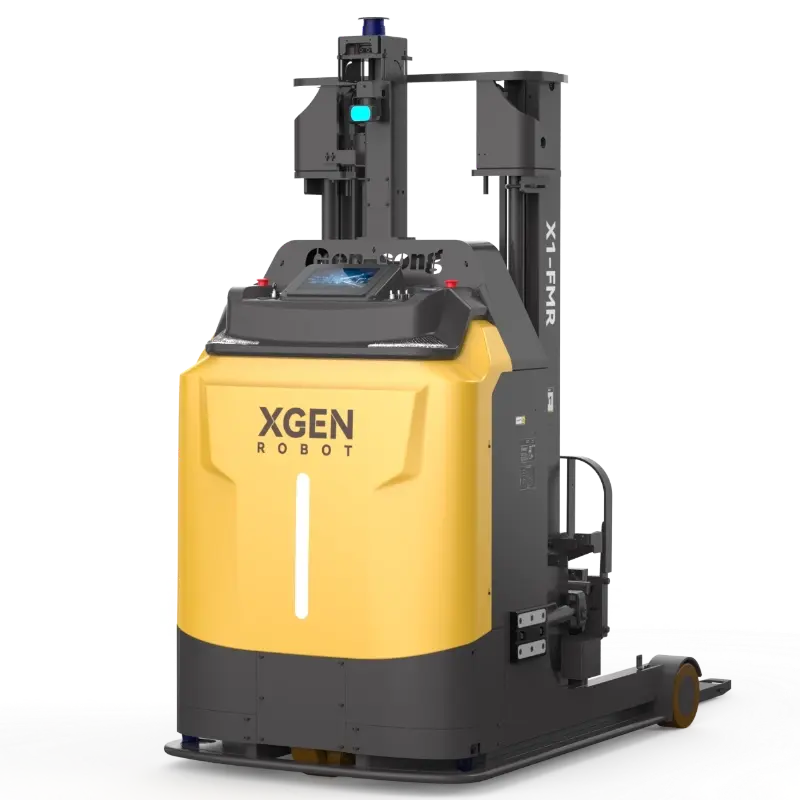
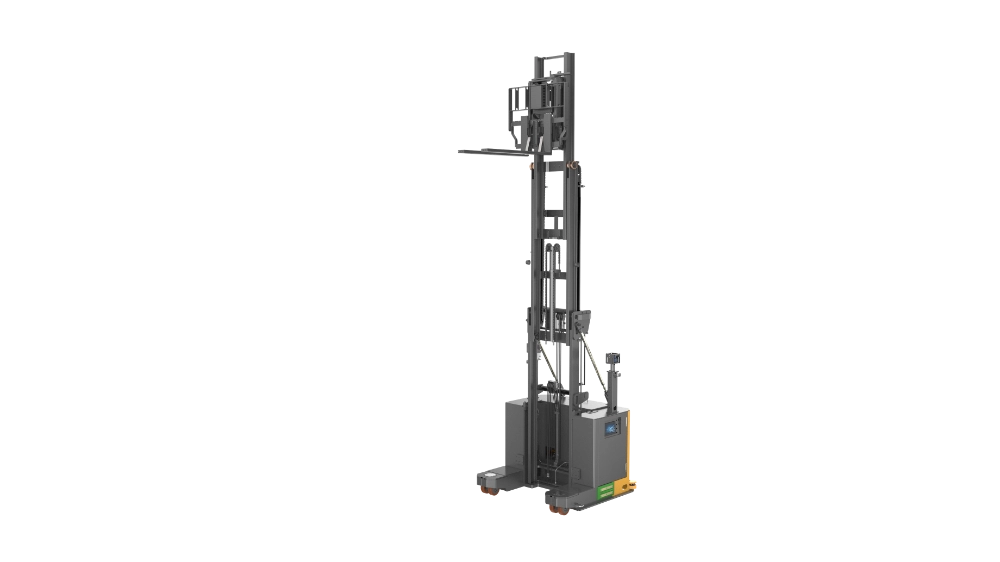
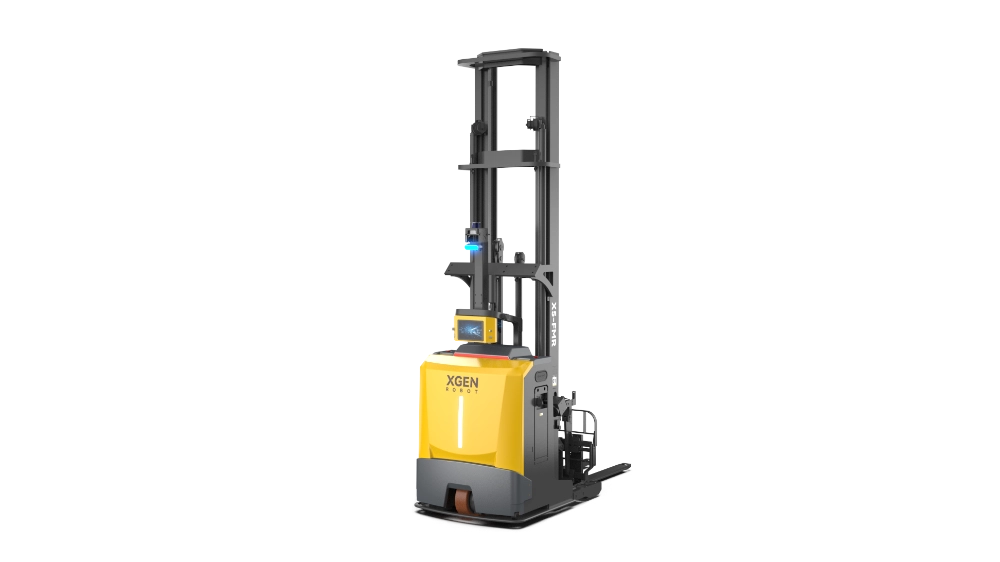
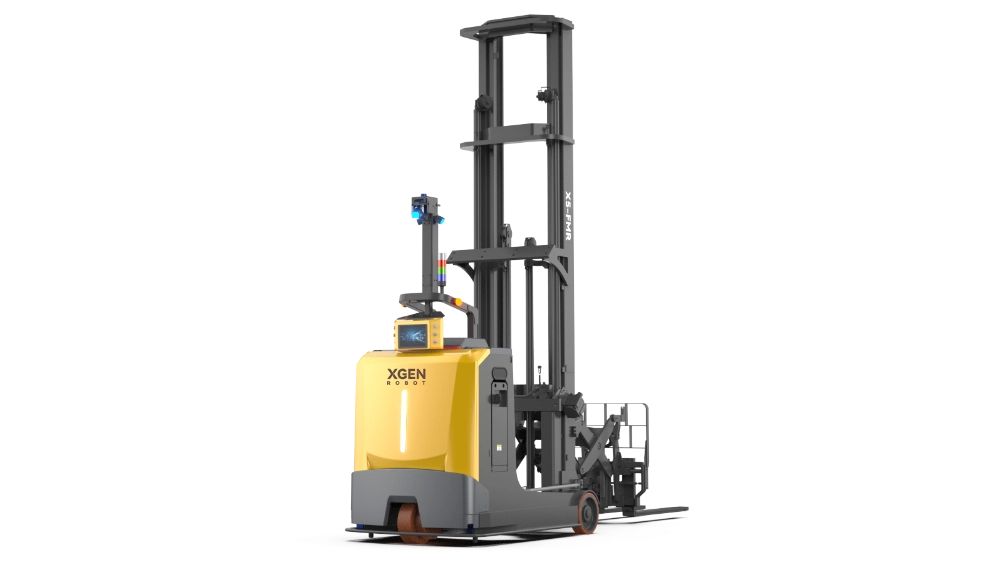
    Small Reach Truck FMR is an FMR with similar functions to reach truck forklifts. It combines the advantages of an electric stacker and a counterbalance forklift. When the mast extends to the top, the load center of gravity falls on the outside of the fulcrum, which is equivalent to a counterbalance forklift. When the mast retracts, the center of gravity of the load falls on the inside of the fulcrum, which is equivalent to a pallet stacker. The combination of these two properties enables operational flexibility and high load performance without increasing its structure or self-weight, greatly saving working space and making it suitable for more occasions.

    Features

    • High Payload with Integrated Storage & Distribution: Enhances operational efficiency and reliability.
    • Multiple Navigation Modes: Ensures precise and safe handling across warehouse environments.
    • Customizable Deployment: Offers tailored solutions for diverse material handling needs.
    • High-Position Stacking: Significantly increases storage capacity by optimizing vertical space utilization.

    TECHNICAL PARAMETERS                                                                                                            ●Standard  ○Optional  -Not  available
      Basic

     Parameters
    Model   No. X1-RT16 X1-RT20
    Load Capacity kg 1600  2000 
    Load Center Distance c(mm) 500  500 
    Weight(incl.battery) kg 2250  2280 
    Fork L×W×H 16*e*s(mm) 1150*122*40 1150*122*40
    Fork Outside Spacing b5(mm) 260-778 260-680
    Forward Reach Distance 14(mm) 560  600 
    Standard Fork Lifting Height h2(mm) 1500  1500 
    3000(standard)/3500/4000/4500 3000(standard)/3500/4000/4500
    4500/5000 4500/5000/5500
    Mast Lowered Height h1(mm) 2142  2142 
    2082/2332/2582/2832 2082/2332/2582/2832
    22971/2462 2297/2462/2627
    Max.Height During Operation h4(mm) 2390  2390 
    3870/4370/4870/5370 3870/4370/4870/5370
    h 5420/5920/6420
    Height of Navigation Top h1'(mm) 2375-2725 2375-2725
    Overall Length(ind.forks) 11(mm) 2182  2372 
    Body Width b1(mm) 1106  1106 
    Min.Ground Clearance m2(mm) 36  36 
    Min.Turning Radius Wa(mm) 1525  1680 
    Wheels:Drive/Load (X=Drive Wheel)   1×12 1x/2
    Min.Safety Distance a(mm) 200  200 
    Aisle Width(1000×1200 along fork,200 clearance) Ast(mm) 2686  2820 
    Aisle Width(1000×1200 across fork,200 clearance) Ast(mm) 2560  2726 
    Aisle Width(1200×1200,R800,200 clearance) Ast(mm) 2930  3052 
    Charging Height h5(mm) 420  420 
    Motion

    Performance
    Drive Type   Steering Wheel Steering Wheel
    Movement Mode   Forward/Backward,Curved Turning Forward/Backward,Curved Turning
    Travel Speed (Loaded/Unloaded) m/s 1.8/2 1.5/1.8
    Max.Gradeability  (Loaded/Unloaded) % 5/8 5/8
    Positioning Accuracyuracy mm ±10 ±10
    Angle Accuracy o ±1 ±1
    Lifting Speed(Loaded/Unloaded) mm/s 120/160 100/160
    Lowering Speed(Loaded/Unloaded) mm/s 160/120 180/120
    Lifting Height Accuracy mm ±5 ±5
    Wired Encoder  
    Cylinder End Buffer  
    Electronic Soft Lift/Lower  
    Battery
    Performance
    Rated Voltageoltage V 48  48 
    Battery Capacityacity Ah 100(150) 125(150,100)
    Battery Low-temp Heating  
    Charging Cycles   Full Charge and Discharge≥3000 Times Full Charge and Discharge≥3000 Times
    Operating Time(Rated Condition) h 4-6(8) 4-6(8)
    Charging Time(30-90%) h
    Charging Mode   Side Charging Side Charging
    Safety
    Protection
    Front Single Laser Obstacle Detection   - -
    Front Dual Laser Obstacle Detection  
    Cargo Placement Detection  
    Pallet Identification  
    Weighing Module  
    Driving Recorder  
    Safety Bumper Detection  
    Pallet In-position Detection  
    Fork Tip Photoelectric Detection  
    Top Anti-collision  
    Left/Right E-stop  
    Tri-color Light &Buzzer  
    Others Laser SLAM Navigation  
    Laser Reflector  
    Visual SLAM Hybrid Navigation  
    10"Display  
    Handle Control   - -
    Wired Controller  
    Mobile APP  
    RFID Reader  
    Working Noise dB ≤75 ≤75
    The above data is sourced from the results obtained through testing by the XGEN Robot Test Team.

    Consult With Specialist

    Get expert advice from our specialist to solve complex problems and optimize your performance efficiently.
    Contact Us

    FAQs

    • What Is FMR?

      FMR stands for Forklift Mobile Robot, which is a type of forklift-style mobile handling robot primarily used for automatic material handling and storage within warehouses.
    • What Handling Or Storage Scenarios Is FMR Suitable For?

      FMR is primarily suitable for common handling and storage scenarios in warehouses, including flat transport, production line connection, cross-floor transportation, and high-level storage.
    • How Much Weight Can FMR Carry, And How High Can It Lift?

      In past project cases of XGEN, the actual implemented maximum load was 30T, and the maximum lifting height was 13.5M.
    • What Are The Advantages Of ASRS Compared To A Traditional Warehouse?

      Compared to traditional warehouses, ASRS have the following advantages: High Space Utilization ASRS makes full use of vertical space with multi-layer shelving and automation equipment, significantly improving storage density and reducing the footprint. High Automation ASRS uses automated equipment such as stackers and conveyor systems, reducing manual labor and increasing operational efficiency and accuracy. Accurate Inventory Management With the use of WMS, ASRS can monitor inventory in real-time, optimizing stock management and reducing overstocking and stockouts. High Operational Efficiency Automated equipment can quickly complete the storage, retrieval, and handling of goods, shortening processing times and improving overall efficiency. Enhanced Safety Automation reduces manual operations, lowering accident risks. Additionally, the system has monitoring and alarm functions that further enhance warehouse safety. Cost Savings Although initial investments may be high, ASRS can significantly reduce operational costs in the long run by reducing labor, improving space utilization, and increasing operational efficiency. Strong Scalability ASRS has a modular design, making it easier to expand or adjust according to changing needs. Environment-friendly Automated equipment reduces energy consumption and carbon emissions, aligning with green and environmental standards.In summary, ASRS outperforms traditional warehouses in space utilization, automation, inventory management, operational efficiency, safety, cost savings, scalability, and environmental friendliness, making them well-suited for modern logistics needs.
    • Can ASRS Be Digitally Managed?

      Yes, ASRS can be digitally managed. Digital management is one of the core advantages of ASRS and is achieved primarily through the following methods: 1. Warehouse Management System (WMS) WMS is the core of digital management in ASRS, enabling real-time inventory monitoring, optimizing storage, managing orders, and processing data to enhance overall operational efficiency. 2. Automation Equipment Integration The automated equipment in ASRS (such as stackers and conveyor systems) is seamlessly connected with the WMS, enabling full-process automation from inbound to outbound operations, reducing manual intervention. 3. Internet of Things (IoT) Technology Through sensors and RFID technology, ASRS can monitor the location, status, and environmental conditions of goods in real-time, ensuring the accuracy and timeliness of inventory data. 4. Data Analysis and Optimization Digital management collects vast amounts of operational data, which is then analyzed to optimize inventory, predict demand, and improve processes, thus increasing warehouse efficiency and reducing costs. 5. Cloud Computing and Big Data Cloud computing and big data technologies support the digital management of ASRS by providing powerful data storage, processing, and analysis capabilities, enabling remote monitoring and management. 6. Artificial Intelligence (AI) and Machine Learning AI and machine learning technologies can be applied to demand forecasting, route optimization, and inventory management, further enhancing the intelligence of the warehouse. 7. Visualization and Real-Time Monitoring Digital management provides visual interfaces and real-time monitoring features, allowing managers to keep track of warehouse status at any time and address issues promptly.
    WhatsApp

    Leave a message!

    Leave a message!

    Email: info@xgenrobot.com