
Table of Contents
With rising warehouse space costs and increasing demand for automation and high-density storage, more and more companies are adopting intelligent warehousing solutions. Among them, the 3-way Very Narrow Aisle (VNA) autonomous forklift has become a key piece of equipment in modern logistics upgrades due to its efficiency, precision, and space-saving advantages.
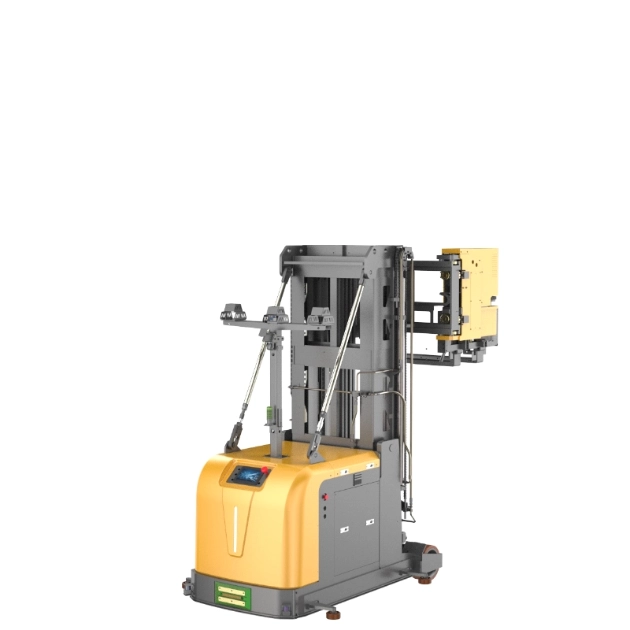
This type of equipment not only operates efficiently in extremely narrow aisles but also significantly improves storage utilization and operational productivity. This article provides a comprehensive guide to the key factors you should consider when selecting a 3-way VNA autonomous forklift, helping businesses make more informed purchasing decisions.
What Is a 3-Way Very Narrow Aisle autonomous Forklift?
A 3-way VNA autonomous forklift is an Automated Guided Vehicle (AGV) specifically designed for high-density warehousing environments. It typically operates in aisles as narrow as 1.6–2.0 meters.
The “3-way” function refers to the fork movement capability:
- Forward picking
- Left-side picking
- Right-side picking
This allows the forklift to handle pallets without turning the vehicle body, greatly improving operational efficiency.
Key Advantages of 3-Way VNA Autonomous Forklifts
1. Maximizing Warehouse Space Utilization
By reducing aisle width requirements, businesses can:
- Increase storage capacity by 30%–50%
- Improve vertical space utilization
- Reduce warehouse expansion costs
2. Reducing Labor Costs
Unmanned forklifts offer:
- 24/7 continuous operation capability
- No need for manual driving
- Reduced human operational errors
This significantly lowers labor costs and management pressure.
3. Improving Operational Safety and Accuracy
Advanced navigation and control systems ensure:
- High-precision positioning
- Automatic obstacle avoidance
- Stable and reliable operation
This effectively reduces collision risks and enhances overall safety.
Key Specifications You Must Consider Before Purchasing
1. Aisle Width Requirements
The equipment must match warehouse layout requirements. VNA systems typically operate in narrow aisles of 1.6–2.0 meters.
2. Lifting Height and Load Capacity
Key factors include:
- Maximum lifting height
- Rated load capacity
These directly affect warehouse efficiency and handling performance.
3. Navigation Technology
Common navigation systems include:
- Laser SLAM navigation
- Magnetic navigation
- QR code navigation
Among them, Laser SLAM 3-Way VNA Autonomous Forklifts is becoming the mainstream choice due to its flexibility and minimal infrastructure requirements.
4. Battery and Charging System
Evaluation points:
- Battery type (Lithium vs Lead-acid)
- Charging time and cycle life
- Opportunity charging capability
Lithium batteries are more suitable for high-intensity continuous operations.
5. System Integration Capability
A high-quality system should seamlessly integrate with:
- Warehouse Management System (WMS)
- Warehouse Control System (WCS)
- ERP systems
This enables data connectivity and intelligent scheduling.
Typical Applications of 3-Way VNA Automated Forklifts
3-way VNA autonomous forklifts are widely used in:
- E-commerce distribution centers
- Manufacturing warehouses
- Cold chain logistics facilities
- Automotive parts warehouses
- High-density automated storage systems
Cost and ROI Analysis of 3-Way VNA Automated Forklifts
When preparing procurement budgets, it is important to compare not only labor costs but also fixed infrastructure systems such as AS/RS (Automated Storage and Retrieval Systems / stacker crane systems).
| Comparison Dimension | 3-Way VNA AGV Forklift | AS/RS Stackers |
| Initial Investment | Moderate (phased deployment possible) | Very high upfront investment |
| Infrastructure Requirements | Minimal (compatible with existing racking) | Extremely high (requires dedicated rails and structures) |
| Flexibility | Very high (cross-aisle movement, relocation possible) | None (fixed rail system) |
| Scalability | Easy (add more vehicles as needed) | Difficult and costly |
Conclusion
3-way VNA autonomous forklifts are a core component of modern intelligent warehousing systems. By improving space utilization, optimizing operational efficiency, and reducing operational costs, they provide significant competitive advantages for businesses.
For companies aiming to upgrade their warehouse automation, selecting the right equipment and a reliable supplier is a critical step toward building an efficient logistics system.
By choosing XGEN ROBOT, you gain a manufacturer advantage with:
- Strict International Safety Certifications
All XGEN ROBOT VNA autonomous forklifts fully comply with ISO 3691-4 (Safety Standards for Industrial Trucks – Driverless Trucks) and CE certification, ensuring safe and compliant operation even at lifting heights of up to 8,000 mm.
- Full Customization & Flexible Integration
We provide an in-house developed fleet management system with open API interfaces, enabling seamless and efficient integration with your WMS/WCS systems while minimizing implementation time and costs.
- Comprehensive Global Delivery & High-Level SLA Support
For overseas distributors and system integrators, XGEN ROBOT provides detailed technical documentation and a dual support system combining remote expert diagnostics with local technical response, backed by a high-standard global Service Level Agreement (SLA).
Welcome to contact the XGEN ROBOT team for a customized solution for 3-way VNA autonomous forklifts.