
The global logistics industry is at a critical stage of paradigm shift. While indoor warehouse automation has largely matured, the “last frontier” remains the unpredictable, harsh, and dynamic outdoor environment. The movement of goods between production facilities, outdoor yards, and loading docks has traditionally been a labor-intensive bottleneck.
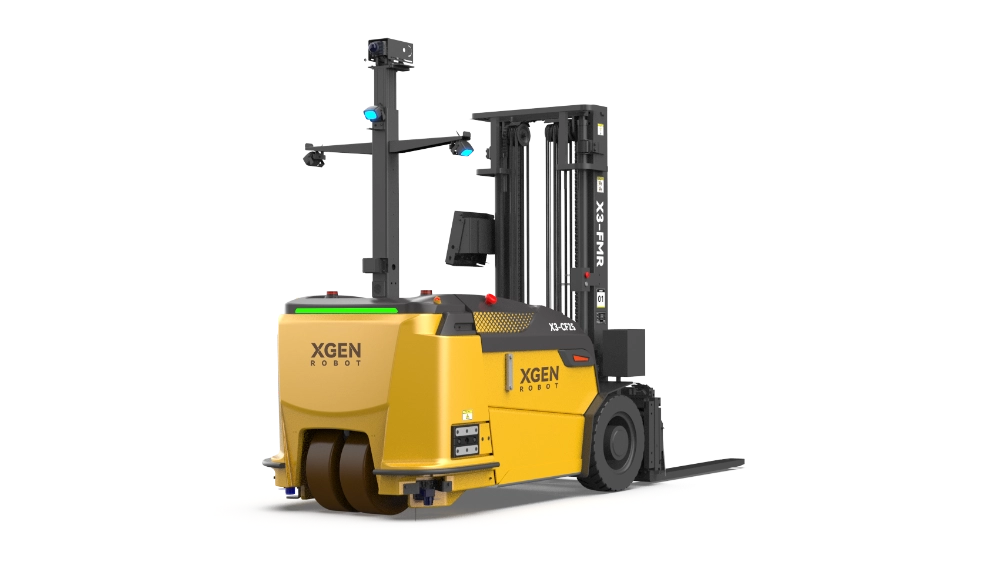
The emergence of counterbalance forklift robots has changed the equation for supply chain managers. Unlike traditional AGVs designed for smooth concrete floors, these robust machines bridge the gap between indoor precision and outdoor durability. In this guide, we will take an in-depth look at how counterbalance technology is transforming outdoor logistics.
1. Why “Counterbalance” Is the Key to Outdoor Success
Unlike stackers that rely on outriggers for support, the center-of-gravity balance logic of the counterbalance structure gives the equipment inherent flexibility. For FMRs, this design means they do not need to consider pallet bottom clearance and can directly handle goods placed on the ground, on flatbed trucks, or on heavy-duty racks.
In unstructured outdoor environments, the advantages of this design are reflected in:
- Versatility in load handling: Without front outriggers, these robots can handle pallets of various sizes and types, including non-standard pallets commonly used in heavy industry and construction.
- Excellent stability: A low center of gravity and optimized weight distribution are critical when dealing with slight slopes and uneven surfaces designed for drainage in outdoor yards.
- High ground clearance: To handle transitions between indoor and outdoor surfaces, higher chassis clearance and specialized tires are required—features that are inherently part of the counterbalance design.
2. Core Pain Points of Outdoor Logistics
The challenges of outdoor environments are enough to disable standard indoor robots within minutes. To solve these issues, we must first categorize the obstacles.
- Dynamic terrain and surface conditions
Indoor floors are predictable, while outdoor yards are filled with cracked asphalt, gravel, speed bumps, and slopes. Robots must continuously calculate their center of gravity, especially when navigating slopes of up to 15%.
- Environmental interference
Precipitation (rain/snow), fog, and dust create “noise” for standard optical sensors. In addition, extreme temperature fluctuations—from -25°C to +55°C—affect battery life and hydraulic oil viscosity.
- Mixed traffic and safety
Unlike enclosed automated areas, outdoor yards are shared spaces with manually operated trucks, pedestrians, and moving obstacles. Ensuring safety in such unstructured environments requires more complex logic than simple “stop-on-obstacle” systems.
3. Technical Comparison: Standard Indoor AGV vs. Outdoor Counterbalance Forklift Robot
To clearly illustrate the technological leap, the table below compares standard equipment with outdoor-specific models across key specifications.
| Specification | Standard Indoor AGV | Outdoor Counterbalance Forklift Robot |
| Navigation Mode | 2D LiDAR | 3D LiDAR |
| Max Slope | < 3% | 10% – 15% |
| Tire Type | Polyurethane | Rubber tires |
| Load Capacity | 0.5 – 1.0 ton | 2.0 – 5.0 tons |
| Protection Level | IP20 / IP54 | IP65 |
| Climate Adaptability | Epoxy / polished concrete | Asphalt, compacted gravel, anti-slip surfaces |
| Ground Adaptability | +5°C to +40°C | -20°C to +50°C |
4. How XGEN Robot’s Outdoor Counterbalance Forklift Robots Solve These Challenges
- Advanced 3D SLAM and navigation
The core of modern counterbalance forklift robots lies in their ability to perceive the three-dimensional world. Through 3D SLAM (Simultaneous Localization and Mapping), robots no longer rely solely on reflectors but instead recognize the geometric structure of the environment. This enables precise positioning even in open yards without traditional landmarks.
- Elastic suspension and rubber tires
Traditional rigid wheels are prone to slipping and generating strong vibrations on gravel surfaces. The rubber tires used by XGEN, combined with a specialized suspension system, can filter out more than 80% of road vibrations, protecting sensitive sensors and batteries.
- Intelligent load perception
Outdoor pallets are rarely positioned with millimeter-level accuracy. With 3D vision cameras, the robot can autonomously detect pallet openings on flatbed trucks or heavy-duty racks and dynamically adjust the fork insertion angle.
5. ROI: The Business Case for Outdoor Automation
Implementing material handling automation in outdoor environments delivers rapid return on investment through three primary channels:
- Eliminating 24/7 operational bottlenecks
Without concerns about night lighting costs or operator fatigue in high temperatures, production throughput remains stable around the clock.
- Minimizing asset damage
Laser-based collision avoidance and millimeter-level operational precision eliminate equipment damage and material waste caused by human error.
- Digital transparency
By integrating outdoor yards directly into the WMS (Warehouse Management System), companies eliminate the “black hole” in yard logistics and achieve real-time tracking of every movement.
If your business is facing challenges such as low outdoor logistics efficiency, high safety risks, or labor shortages, and you want to explore more about autonomous material handling solutions, visit XGEN Robot.