
As warehouse land costs, labor expenses, and order fulfillment requirements continue to increase, more companies are adopting high-density storage systems and automated material handling solutions. For warehouses equipped with high-bay racking and very narrow aisles, an autonomous three-way VNA forklift combines narrow aisle storage with automated material handling to achieve more efficient pallet storage and retrieval within limited warehouse space.
Compared with conventional forklifts, a three-way VNA forklift can operate in narrow aisles while using a three-directional fork system to reduce the need for vehicle turning. When integrated with laser navigation, sensors, intelligent control systems, and fleet management software, an autonomous VNA forklift can perform automated navigation, pallet transportation, and high-level storage and retrieval tasks.
However, for companies purchasing an autonomous narrow aisle forklift for the first time, the biggest challenge is not simply understanding what the equipment is, but determining which solution is right for their warehouse.
Aisle width, rated load capacity, lift height, pallet dimensions, navigation technology, positioning accuracy, battery system, safety functions, and WMS/WCS integration can all have a significant impact on equipment performance and overall return on investment.
This guide covers the key factors involved in selecting an autonomous three-way VNA forklift, including warehouse requirements, technical specifications, automation functions, system integration, and supplier selection.
What Is an Autonomous Three-Way VNA Forklift?
An autonomous three-way VNA forklift is an automated material handling vehicle designed for high-density warehouse environments with very narrow aisles. It combines VNA forklift technology, a three-way fork system, and autonomous navigation to transport pallets and perform high-level storage and retrieval operations within limited aisle space.
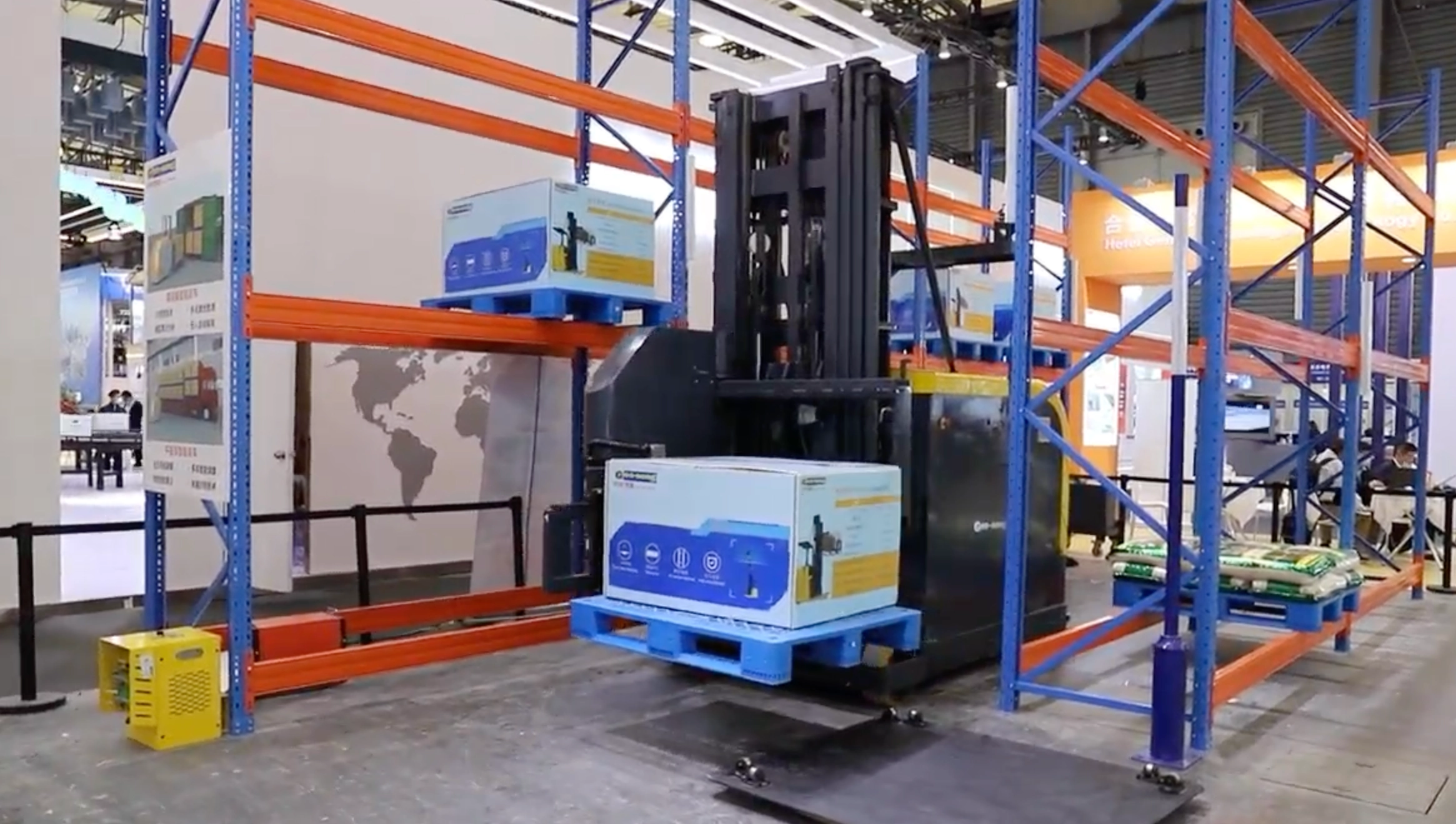
Unlike conventional forklifts, which generally need to turn the entire vehicle when picking up or placing loads, a three-way VNA forklift can use fork rotation and lateral movement to handle pallets from different directions. This reduces the amount of turning space required inside the aisle.
When combined with an autonomous navigation system, the forklift can receive tasks from a warehouse management or fleet management system, automatically travel to the designated location, and complete pallet handling operations with minimal manual intervention.
As a result, autonomous three-way VNA forklifts are particularly suitable for high-bay warehouses, narrow aisle storage systems, and pallet-intensive logistics operations.
Why Are Companies Adopting Autonomous VNA Forklifts?
Improve Warehouse Space Utilization
For companies facing high warehouse costs or limited floor space, increasing storage capacity per square meter can be more cost-effective than simply expanding the warehouse.
A VNA warehouse system reduces the amount of floor space required for forklift aisles, allowing more racks to be installed within the same building footprint. A three-way forklift can further reduce turning requirements, making it suitable for compact warehouse layouts.
For manufacturing facilities, third-party logistics providers, e-commerce fulfillment centers, and distribution warehouses that handle large volumes of palletized goods, improved storage density can have a direct impact on warehouse operating costs.
Reduce Repetitive Manual Material Handling
Pallet receiving, put-away, picking, and internal transportation are often repetitive warehouse tasks. When a facility handles a high volume of similar movements every day, an autonomous forklift can execute predefined transportation and storage tasks automatically.
This can reduce reliance on manual forklift operators while helping minimize productivity fluctuations caused by fatigue, operator differences, or labor turnover.
For warehouses operating multiple shifts, autonomous forklifts can also work with automated charging and fleet management systems to improve equipment utilization.
Improve High-Level Storage and Retrieval Stability
VNA warehouses have limited aisle space, making positioning accuracy particularly important when operating around high-bay racks.
An autonomous forklift can use LiDAR, positioning systems, and sensors to continuously detect its position and surrounding environment. The vehicle can follow a predefined route and perform precise positioning when approaching pallets and storage locations.
Therefore, when selecting an autonomous VNA forklift, companies should look beyond maximum driving speed and pay close attention to positioning accuracy, fork positioning performance, and high-level operation stability.
What Should You Consider When Buying an Autonomous Three-Way VNA Forklift?
Purchasing an autonomous narrow aisle forklift should not be based solely on equipment price or a single technical specification. A better approach is to evaluate the forklift according to the actual warehouse environment and material handling workflow.
1. Aisle Width
Aisle width is one of the most important parameters when selecting a VNA forklift.
The actual aisle requirement depends not only on the forklift itself, but also on several warehouse and load factors, including:
- Pallet dimensions
- Load dimensions
- Racking configuration
- Forklift dimensions
- Fork length
- Pallet handling direction
- Floor flatness
- Required safety clearance
For this reason, companies should not select equipment simply based on the “minimum aisle width” advertised by a supplier.
Before starting a project, it is recommended to provide the forklift manufacturer with warehouse layout drawings, rack specifications, pallet dimensions, and load information. A professional engineering team can then evaluate the actual aisle requirements and determine whether the proposed 3-way VNA forklift can operate safely and efficiently.
2. Rated Load Capacity
Load capacity determines how much weight the forklift can safely handle.
For example, if most pallets in a warehouse weigh approximately 800 kg, a 1,000 kg-capacity forklift may be suitable for the basic application. However, warehouses handling 1.5-ton or 2-ton pallets may require a higher-capacity model.
It is also important to understand that a forklift’s rated capacity can be affected by load center distance and lift height.
Therefore, when evaluating an autonomous forklift, do not focus only on the maximum rated load listed on the product page. Ask the supplier:
What is the actual rated capacity at the required lifting height and load center?
This is particularly important for high-bay storage applications.
3. Maximum Lift Height
For warehouses using high-level pallet racking, lift height is another critical selection factor.
Companies should choose the lift height according to the actual rack configuration rather than simply selecting the model with the highest possible lifting capability.
The required lift height should be evaluated together with:
- Highest storage position
- Load height
- Pallet height
- Top-rack safety clearance
- Warehouse clear height
- Fire sprinkler systems
- Lighting equipment
- Mast configuration
Choosing an appropriate lift height can help meet storage requirements without paying for unnecessary lifting capacity.
4. Navigation Technology
Navigation technology is at the core of autonomous forklift operation.
Common navigation technologies for autonomous forklifts include LiDAR SLAM, QR code navigation, and magnetic navigation. Different technologies are suitable for different warehouse environments.
For warehouses where rack layouts may change in the future, LiDAR-based navigation can provide greater flexibility because the system can use environmental features for positioning rather than relying entirely on fixed magnetic strips or markers.
When evaluating an autonomous VNA forklift, companies should ask:
- What navigation technology does the forklift use?
- Does the system require magnetic strips or QR codes?
- How long does mapping and commissioning take?
- How easily can the system adapt to warehouse layout changes?
- Does the forklift support dynamic obstacle avoidance?
- Does it support multi-vehicle coordination?
These questions provide more meaningful information than simply asking whether the forklift “supports autonomous navigation.”
5. Positioning Accuracy
Narrow aisle warehouses generally require higher positioning accuracy than conventional warehouse environments.
If the forklift deviates significantly while entering a narrow aisle, it may affect fork alignment with the pallet and increase the risk of contact with the racking system.
Therefore, buyers should evaluate three aspects:
Vehicle positioning accuracy + fork positioning accuracy + high-level operation accuracy.
The actual positioning performance should also be evaluated in relation to warehouse floor conditions, rack structure, pallet specifications, and the overall operating environment.
Safety Features of an Autonomous Three-Way VNA Forklift
Safety is a critical consideration in any autonomous forklift project.
Because VNA forklifts operate in environments where the vehicle may run close to racks on both sides, the system needs to continuously detect people, pallets, racks, and other obstacles.
A mature autonomous forklift solution typically combines LiDAR, safety sensors, collision detection, and intelligent control systems to automatically slow down or stop when potential obstacles are detected.
When evaluating an autonomous three-way forklift, companies should consider features such as:
- LiDAR-based obstacle detection
- Collision avoidance
- Safety zone management
- Emergency stop functions
- Person detection
- Load detection
- Fault alarms
- High-level lifting safety controls
- Multi-vehicle coordination and avoidance
For overseas warehouse automation projects, buyers should also verify the applicable safety standards and certification requirements in the target market.
Why Battery and Automatic Charging Matter
If an autonomous VNA forklift is expected to operate across multiple shifts, the battery system can have a direct impact on equipment availability and productivity.
Key factors include:
Battery capacity, charging time, operating time, and battery service life.
For high-throughput warehouse operations, it is also worth checking whether the forklift supports automatic charging or opportunity charging.
With an automatic charging system, an autonomous forklift can travel to a designated charging station when its battery level is low, reducing the need for manual intervention.
More importantly, the battery strategy should be coordinated with the fleet management system. Simply installing a larger battery on every forklift is not always the most efficient solution.
Can an Autonomous VNA Forklift Integrate with WMS and WCS?
In a smart warehouse, the autonomous forklift is only one part of the overall automation system.
Companies should evaluate whether the forklift can communicate with systems such as:
- WMS (Warehouse Management System)
- WCS (Warehouse Control System)
- ERP (Enterprise Resource Planning)
For example, when the WMS creates a pallet put-away task, the WCS can assign the task based on warehouse requirements and vehicle availability. The autonomous forklift can then travel to the designated location and complete the pallet handling operation.
Before purchasing an autonomous forklift, companies should confirm whether the supplier provides:
- API interfaces
- Standard communication protocols
- Task scheduling interfaces
- Fleet management systems
- WMS/WCS integration
- Data monitoring
- Equipment status monitoring
- Remote diagnostics
If a company plans to add AMRs, conveyors, stacker cranes, or AS/RS systems in the future, an open system architecture can also make future automation expansion easier.
Which Warehouses Are Suitable for Autonomous Three-Way VNA Forklifts?
An autonomous VNA forklift is not necessary for every warehouse. It is particularly suitable for facilities with high-density pallet storage, narrow aisles, high-bay racking, and repetitive material handling tasks.
Typical applications include:
Manufacturing Warehouses
Autonomous VNA forklifts can be used for raw material and finished-goods storage in industries such as automotive components, machinery, electronics, and industrial manufacturing.
Third-Party Logistics Warehouses
Warehouses handling large volumes of standardized pallets and frequent inbound and outbound movements can benefit significantly from automated pallet handling.
E-Commerce Fulfillment Centers
For warehouses with large SKU volumes and frequent order processing, autonomous material handling can reduce repetitive manual operations and improve workflow consistency.
Cold Storage Warehouses
Cold storage facilities typically involve high construction and operating costs. Increasing vertical storage density through VNA warehouse layouts can therefore help maximize the value of available storage space.
High-Density Distribution Centers
For distribution centers that need to store large quantities of palletized goods within a limited building footprint, a three-way VNA forklift can provide a flexible solution for high-level pallet storage and retrieval.
Autonomous VNA Forklift vs. Traditional VNA Forklift
Both autonomous and traditional VNA forklifts can operate in narrow aisles and high-bay warehouse environments. The key difference is the level of automation and method of operation.
A traditional VNA forklift relies primarily on a human operator to drive, position, pick up, and place loads.
An autonomous VNA forklift uses navigation systems, sensors, control software, and fleet management technology to perform these tasks automatically.
Therefore, companies should not evaluate the two solutions only by comparing their initial purchase prices.
For high-density, high-volume, and repetitive pallet handling operations, the long-term value of an autonomous VNA forklift can include not only reduced labor requirements but also improved warehouse space utilization, operational consistency, and data-driven warehouse management.
How to Choose an Autonomous Three-Way VNA Forklift Supplier?
When selecting a supplier, companies should evaluate four key areas: product capability, software capability, project experience, and after-sales service.
First, confirm whether the supplier has its own autonomous forklift R&D and manufacturing capabilities. Understanding the supplier’s capabilities in vehicle control, navigation, and automation software can help determine the maturity of the overall solution.
Second, evaluate the supplier’s capabilities in navigation, positioning, fleet management, and warehouse system integration. A mature autonomous forklift solution should not simply turn a conventional forklift into a driverless vehicle; it should be capable of becoming part of the company’s broader warehouse automation system.
Third, project experience is important. Warehouse floor conditions, rack heights, pallet sizes, traffic patterns, and material handling workflows can vary significantly from one facility to another. A supplier with experience in similar projects can usually provide more practical system design and implementation.
Finally, overseas customers should pay attention to installation and commissioning, technical training, remote support, spare parts availability, and after-sales response times.
Key Parameters to Confirm Before Buying
Before requesting a quotation for an autonomous three-way VNA forklift, companies should prepare detailed project information.
At a minimum, buyers should provide:
Warehouse information: warehouse area, aisle width, rack height, floor conditions, and clear warehouse height.
Load information: pallet dimensions, maximum load dimensions, average load weight, maximum load weight, and load center distance.
Operation information: daily pallet movements, inbound tasks, outbound tasks, operating shifts, and peak workload.
Equipment requirements: rated load capacity, lift height, travel speed, positioning accuracy, battery capacity, and automatic charging requirements.
System requirements: WMS/WCS/ERP interfaces, fleet management, task scheduling, data monitoring, and remote diagnostics.
Once these parameters are clearly defined, an experienced supplier can more accurately determine which autonomous three-way VNA forklift is suitable for the project.
Conclusion
The autonomous three-way VNA forklift is becoming an important automation solution for high-density warehouse operations. By combining VNA technology, three-way pallet handling, autonomous navigation, and intelligent fleet management, it can help companies maximize warehouse space utilization while reducing repetitive manual material handling.
However, choosing the right 3-way VNA forklift should involve more than comparing purchase prices or maximum lift heights. Companies should evaluate aisle width, load capacity, lift height, navigation technology, positioning accuracy, battery performance, safety functions, and WMS/WCS integration as part of a complete warehouse automation strategy.
For companies planning to upgrade their warehouse operations, the best equipment selection should be based on actual warehouse data, pallet requirements, material flow, and long-term automation goals.
If you are looking for an autonomous three-way VNA forklift for high-density warehouse applications, XGEN Robot can provide autonomous forklift and intelligent material handling solutions based on your warehouse layout, pallet specifications, load requirements, and automation objectives.