
As warehouse operations become increasingly automated, small automated reach trucks are emerging as a practical solution for pallet storage and retrieval in high-density warehouse environments. By combining the compact structure and high-level handling capabilities of traditional reach trucks with autonomous navigation and intelligent control, they can improve warehouse space utilization while reducing repetitive manual forklift operations.
However, choosing an automated reach truck is not simply about comparing lifting height or purchase price. The equipment needs to be properly matched with the warehouse layout, racking system, pallet specifications, and overall automation architecture. The following five factors are particularly important when selecting a small automated reach truck.
1. Load Capacity and Lifting Performance
Load capacity and lifting height are the basic factors to consider when selecting a reach truck. The right equipment must be capable of safely handling pallets at the actual operating height and weight required by the application.
When evaluating technical specifications, it is important not to focus solely on rated capacity. Load center, lifting height, mast configuration, and residual capacity should also be considered. As lifting height increases, the actual load capacity of a forklift may change. Therefore, rated capacity alone may not fully reflect the truck’s real performance in high-level storage applications.
When selecting an automated reach truck, warehouse operators should provide information such as actual pallet weight, pallet dimensions, rack height, and storage requirements. This allows the equipment to be configured according to the specific application rather than selected solely based on standard specifications.
2. Compact Dimensions and Narrow-Aisle Performance
Space utilization is one of the key reasons companies choose small reach trucks.
A compact automated reach truck can operate in narrower aisles and, when properly matched with the racking system, help increase storage density. Factors such as vehicle width, turning radius, fork dimensions, reach distance, and navigation safety clearance can all affect the minimum required operating aisle width.
Therefore, the equipment should not be evaluated separately from the warehouse racking layout. A forklift that appears highly compact on a specification sheet may still require additional safety clearance in actual operation, depending on pallet dimensions, rack configuration, and pallet positioning accuracy requirements.
For high-density storage environments, the goal is not simply to choose the smallest possible vehicle. Instead, businesses should find the right balance between vehicle size, storage density, operational safety, and handling efficiency.
3. Autonomous Navigation and Positioning Accuracy
Autonomous navigation is one of the most important differences between an automated reach truck and a conventional forklift.
A reliable autonomous navigation system needs to accurately determine the vehicle’s position, efficiently plan routes, detect surrounding obstacles, and continuously perform pallet handling tasks. Depending on the application, technologies such as laser navigation, SLAM, vision perception, and multi-sensor fusion can be used to enable autonomous operation.
Positioning accuracy is particularly important in rack storage applications. The vehicle needs to approach storage locations precisely and coordinate its movements with racks and pallets. Even relatively small positioning errors can affect pallet retrieval efficiency, load placement accuracy, and overall operational safety.
In addition, integration with warehouse control systems is another factor worth considering. A professional automated reach truck solution should be capable of communicating with WMS, WCS, or a Fleet Management System, depending on project requirements. This allows pallet storage and retrieval to become part of the overall warehouse logistics system rather than an isolated operation.
4. Safety and Stable Operation in Complex Environments
Automation does not mean that safety management can be overlooked.
In many warehouses, automated equipment operates alongside workers, conventional forklifts, pallets, racks, and other mobile robots. Therefore, the safety system of an automated reach truck needs to address environmental perception, obstacle detection, speed control, emergency stopping, and safe interaction with surrounding equipment.
These functions become even more important in narrow-aisle and high-density storage environments, where operating space is limited. A well-designed automated reach truck should maintain stable navigation and safe stopping performance and respond quickly when warehouse conditions change.
For commercial applications, buyers should also evaluate the manufacturer’s capabilities in safety validation, system commissioning, equipment maintenance, and after-sales technical support, rather than comparing hardware specifications alone.
5. System Integration and Total Cost of Ownership
The final consideration should not be the initial purchase price, but the long-term value of the entire automation solution.
An automated reach truck is usually only one component of a complete warehouse automation system. Its actual operating performance may depend on coordination with WMS/WCS, charging infrastructure, fleet management systems, racking, conveyor systems, and other automated material handling equipment.
Even if the vehicle itself offers excellent performance, insufficient system integration can prevent the warehouse from achieving the expected level of automation.
Therefore, when calculating Total Cost of Ownership (TCO), companies should consider equipment investment, software systems, installation and commissioning, charging or battery systems, maintenance, spare parts, and future system upgrades.
At the same time, businesses should evaluate the actual operational value created by automation, including reduced dependence on manual forklift operations, improved consistency in pallet handling, increased storage density, and greater equipment availability.
If an automated system can continuously improve warehouse productivity and space utilization, a relatively higher initial investment may still provide a strong long-term return on investment.
Small Automated Reach Trucks for High-Density Warehousing
The core value of a small automated reach truck lies in combining compact vehicle dimensions, high-level pallet handling capabilities, and autonomous operation.
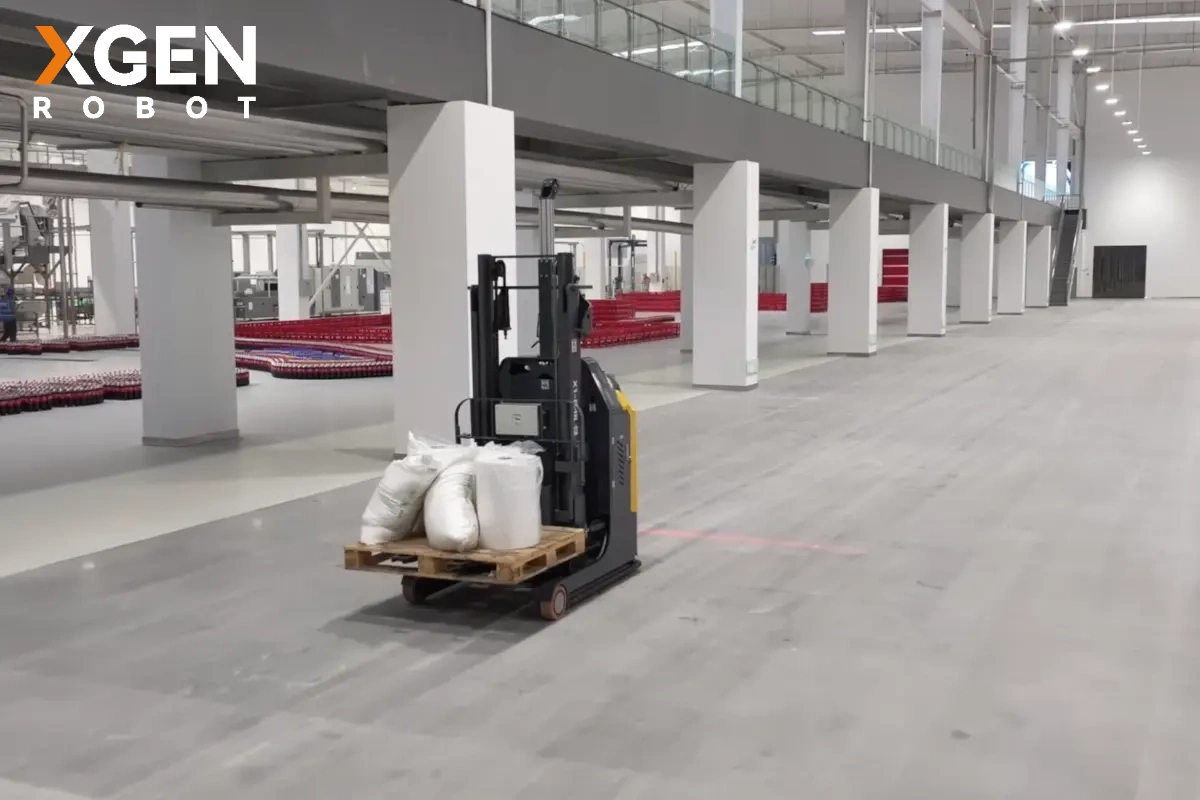
These characteristics make automated reach trucks particularly suitable for applications that require both high storage density and a high degree of automation, including:
- Manufacturing facilities
- Distribution centers
- 3PL warehouses
- Automotive manufacturing
- Electronics manufacturing
- Pallet-based storage facilities
However, warehouse automation should always be designed around the actual material flow and operational requirements. Before purchasing equipment, businesses should carefully analyze pallet specifications, racking layout, aisle width, storage height, daily pallet handling volume, charging requirements, and system integration requirements.
XGEN Robot Automated Reach Truck Solution
XGEN Robot focuses on intelligent material handling and warehouse automation solutions. Its automated reach truck is designed to perform functions similar to a conventional reach truck while combining the advantages of an electric stacker and a counterbalance forklift. It offers a maximum load capacity of 1.6 tons. When the mast is retracted, the load center moves inward, allowing the vehicle to function as a pallet stacker.
By integrating automated pallet handling with warehouse management systems and fleet management systems, the solution can become part of a complete intelligent material handling system rather than operating as an independent automated vehicle.
For businesses looking to increase storage density and gradually reduce their dependence on manual forklift operations, this dual-function design provides high load capacity and operational flexibility without increasing the overall vehicle dimensions or weight. This helps save valuable working space and allows the equipment to adapt to a variety of warehouse applications.
Frequently Asked Questions About Automated Reach Trucks
What factors should be considered when purchasing an automated reach truck?
The main factors include load capacity, lifting height, vehicle dimensions, aisle width, positioning accuracy, navigation technology, safety performance, system integration capabilities, and total cost of ownership.
Can automated reach trucks operate in narrow aisles?
Yes. Compact automated reach trucks are particularly suitable for narrow-aisle and high-density warehousing applications. However, the actual required aisle width depends on vehicle dimensions, pallet specifications, racking layout, and specific operating requirements.
Can an automated reach truck be integrated into an existing warehouse?
Yes. In many cases, existing warehouses can introduce automated reach trucks through a phased automation approach. However, feasibility depends on factors such as racking layout, floor conditions, warehouse traffic, pallet specifications, and system integration requirements.
Conclusion
Choosing the right small automated reach truck requires a comprehensive evaluation of equipment performance, warehouse conditions, automation technology, safety, and long-term operating costs. The most suitable equipment is not necessarily the smallest or most powerful model. Instead, it should provide the right balance between storage density, handling efficiency, operational safety, and system scalability.
With proper equipment selection and automation system design, small automated reach trucks can help warehouses achieve more efficient, flexible, and intelligent pallet storage and handling operations.