
Table of Contents
As warehouse automation continues to evolve, more businesses are turning to intelligent material handling solutions to improve efficiency and reduce labor costs. Among these technologies, autonomous pallet stackers have become a key component in modern intralogistics systems.
In this guide, we’ll cover everything you need to know about autonomous pallet stackers, including how they work, their benefits, applications, and how to choose the right solution for your warehouse.
What Is an Autonomous Pallet Stacker?
An autonomous pallet stacker is a type of forklift mobile robot (FMR) designed to automatically lift, transport, and stack palletized goods without human intervention.
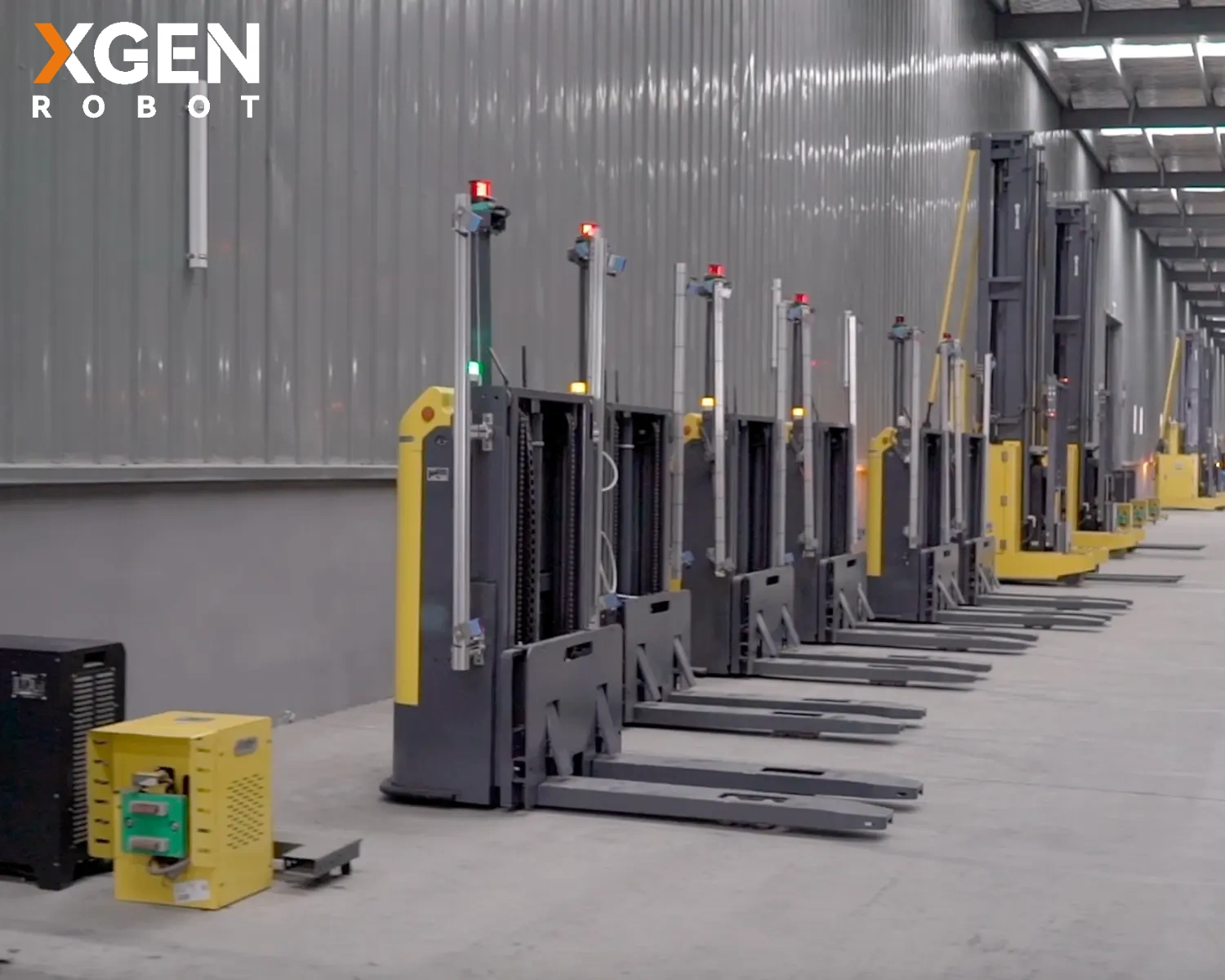
Unlike traditional electric pallet stackers, autonomous models use advanced technologies such as:
- Laser SLAM navigation
- Sensors and obstacle detection
- Intelligent path planning
- Fleet management systems
These features enable the robot to operate safely and efficiently in dynamic warehouse environments.
Key Features of Autonomous Pallet Stackers
1. Intelligent Navigation
Autonomous pallet stackers typically use Laser SLAM (Simultaneous Localization and Mapping) technology to navigate without fixed infrastructure. This allows flexible deployment and easy adaptation to layout changes.
2. Automatic Pallet Handling
They can perform tasks such as:
- Pallet pickup and drop-off
- Vertical stacking and de-stacking
- High-bay storage operations
3. Narrow Aisle Operation
Designed for high-density warehouses, these robots can operate in narrow aisles, maximizing storage space utilization.
4. Safety and Obstacle Avoidance
Equipped with multiple sensors, they can:
- Detect obstacles in real time
- Avoid collisions
- Ensure safe human-robot collaboration
5. Fleet Coordination
Through centralized control systems, multiple pallet stackers can work together to optimize workflow and improve overall efficiency.
Benefits of Using Autonomous Pallet Stackers
Improve Warehouse Efficiency
Autonomous pallet stackers operate continuously with consistent performance, significantly improving throughput and reducing bottlenecks.
Reduce Labor Costs
By replacing manual stacking operations, businesses can lower labor dependency and minimize human errors.
Enhance Space Utilization
With precise control and narrow aisle capability, these pallet stackers robots enable high-density storage, making better use of vertical space.
Increase Safety
Automation reduces the risk of accidents caused by manual forklift operation, especially in busy warehouse environments.
Scalable Automation
Autonomous pallet stackers can be easily scaled by adding more units as business needs grow.
Application scenarios of autonomous pallet stacker
Autonomous pallet stackers are widely used across various industries, including:
- Warehousing and distribution centers
- Manufacturing facilities
- E-commerce fulfillment centers
- Food and beverage logistics
- Cold chain storage
They are especially suitable for:
- High-bay warehouses
- Narrow aisle environments
- Repetitive pallet stacking tasks
Autonomous Pallet Stacker vs Traditional Pallet Stacker
| Feature | Autonomous Pallet Stacker | Traditional Electric Stacker |
| Operation | Fully automated | Manual |
| Efficiency | High | Medium |
| Labor Cost | Low | High |
| Safety | High | Depends on operator |
| Flexibility | High | Limited |
Autonomous pallet stackers provide a smarter and more efficient alternative to traditional equipment, especially in modern automated warehouses.
How to Choose the Right Autonomous Pallet Stacker
When selecting an autonomous pallet stacker, consider the following factors:
Load Capacity
Choose a model that matches your pallet weight requirements, typically ranging from 1T to 3T or more.
Lifting Height
For high-bay storage, ensure the stacker can reach the required height (e.g., 5m).
Warehouse Layout
Evaluate aisle width, racking design, and floor conditions to ensure compatibility.
Navigation Technology
Look for advanced navigation systems such as SLAM for flexibility and ease of deployment.
Integration Capability
Ensure the system can integrate with your existing WMS (Warehouse Management System) or ERP.
Future Trends in Autonomous Pallet Stacking
As automation technology advances, autonomous pallet stackers are expected to become:
- More intelligent with AI-driven optimization
- More collaborative with human workers
- More integrated into full warehouse automation systems
They will play a crucial role in building smart warehouses and Industry 4.0 ecosystems.
Conclusion
Autonomous pallet stackers are transforming warehouse operations by combining efficiency, safety, and flexibility. For businesses looking to upgrade their material handling systems, they offer a powerful solution for achieving higher productivity and lower operational costs.
If you are planning to implement warehouse automation, investing in autonomous pallet stackers is a strategic step toward future-ready logistics.
Frequently Asked Questions (FAQ) about Automated Pallet Stacker
What is the difference between an autonomous pallet stacker and an AGV?
An autonomous pallet stacker is a type of forklift mobile robot (FMR) designed for pallet lifting and stacking operations, including high-bay storage. In contrast, traditional AGVs are mainly used for horizontal transportation and typically do not have lifting capabilities.
What types of warehouses are suitable for autonomous pallet stackers?
Autonomous pallet stackers are suitable for a wide range of environments, including high-bay warehouses, narrow aisle storage systems, e-commerce fulfillment centers, manufacturing facilities, and cold chain logistics. They are especially ideal for operations requiring high-density storage and repetitive stacking tasks.
Can autonomous pallet stackers replace manual forklifts?
Yes, in most repetitive pallet handling and stacking operations, autonomous pallet stackers can effectively replace manual forklifts. They help reduce labor costs, improve efficiency, and enhance operational safety, making them a key solution for warehouse automation.
Get in Touch
Looking for a reliable autonomous pallet stacker solution?
Contact XGEN today to explore customized forklift mobile robot (FMR) solutions tailored to your warehouse needs.