
Table of Contents
The next order wave is ready, but the packing area is still occupied by the previous batch. A partly used pallet needs to return to storage, empty pallets need collecting, and replacement materials are waiting for a driver. In this situation, the delay is not a lack of picking speed. It is the time needed to reset the material flow.
An autonomous pallet truck can help shorten these transitions by moving compatible palletized loads between defined locations. Hydraulic lifting enables the truck to pick up and set down pallets rather than simply carry a load placed on top of it. The benefit depends on how well pickup, transport and handover fit the surrounding operation—not on automation alone.
What does changeover mean in a mixed-SKU warehouse?
Here, changeover means the interval between finishing one order batch or replenishment cycle and having the next work package ready at the workstation. It is different from changing tooling on a production machine. Relevant activities may include clearing residual stock, removing empty pallets, delivering packaging materials and replenishing the next batch.
A pallet truck addresses the transport portion of that interval. It does not select individual SKUs, verify carton contents or replace workstation preparation. If the real bottleneck is order release, product verification or packing-machine setup, faster pallet movement alone may have little effect.
Where hydraulic lifting makes a difference
A robotic pallet truck combines travel with fork-based pickup and placement. On compatible pallets and suitable floors, a short hydraulic lift raises the load clear of the ground for horizontal transport. This can remove the need for a separate vehicle or operator at each end of a routine transfer.
Low-lift handling should not be confused with stacking. A truck with a 120 mm maximum lift is intended for low-level pallet movement, not placing goods into high racks. Buyers should also verify fork-entry clearance, pallet bottom-board geometry and load stability; the word “pallet” does not guarantee compatibility.
How to shorten the transition between batches
Clear the outgoing pallet before it blocks the next task
Define a return destination for residual stock and a separate location for empty pallets. Once an operator or connected system confirms that the outgoing load is ready, a transport mission can be released. The practical objective is to avoid having a completed batch occupy the only usable replenishment position.
Do not assume the robot can decide whether a pallet contains usable stock, waste or an incomplete order. Those decisions require agreed identification and release procedures.
Stage the next load without crowding the workstation
A designated buffer can separate material delivery from the exact moment a workstation needs the pallet. Plan the next load around order readiness and available buffer space, rather than sending every replenishment request immediately. A full buffer should prevent another delivery from being released.
For example, a packing team switching from one product family to another could have the next packaging-material pallet staged nearby while the previous pallet is returned. This is a proposed workflow, not a measured performance result. It only works if the buffer remains outside pedestrian routes and emergency access areas.
Make the handover predictable
Mark pickup positions, define acceptable pallet orientation and keep destinations clear. Pallet recognition and navigation accuracy support docking, but neither guarantees successful fork entry with a damaged pallet or an obstructed pocket. Test the complete pickup-and-placement sequence with representative loads, not just an empty vehicle following a route.
Treat exceptions as part of the process
Agree what happens when the destination is occupied, a pallet is missing, a route is blocked or a mission is interrupted. Assign responsibility for recovery and decide how completion is confirmed. A truck that reaches a location has not necessarily completed a verified material handover.
Match the truck to the job—not just the payload
For a concrete equipment reference, XGEN Robot offers the X1-PT10 and X1-PT15 hydraulic-lift pallet trucks with rated capacities of 1,000 kg and 1,500 kg, respectively, and a maximum lift of 120 mm. Both list ±10 mm positioning accuracy and pallet identification. The product family uses laser SLAM navigation, but navigation and accessory configurations differ by model and should be confirmed during quotation.
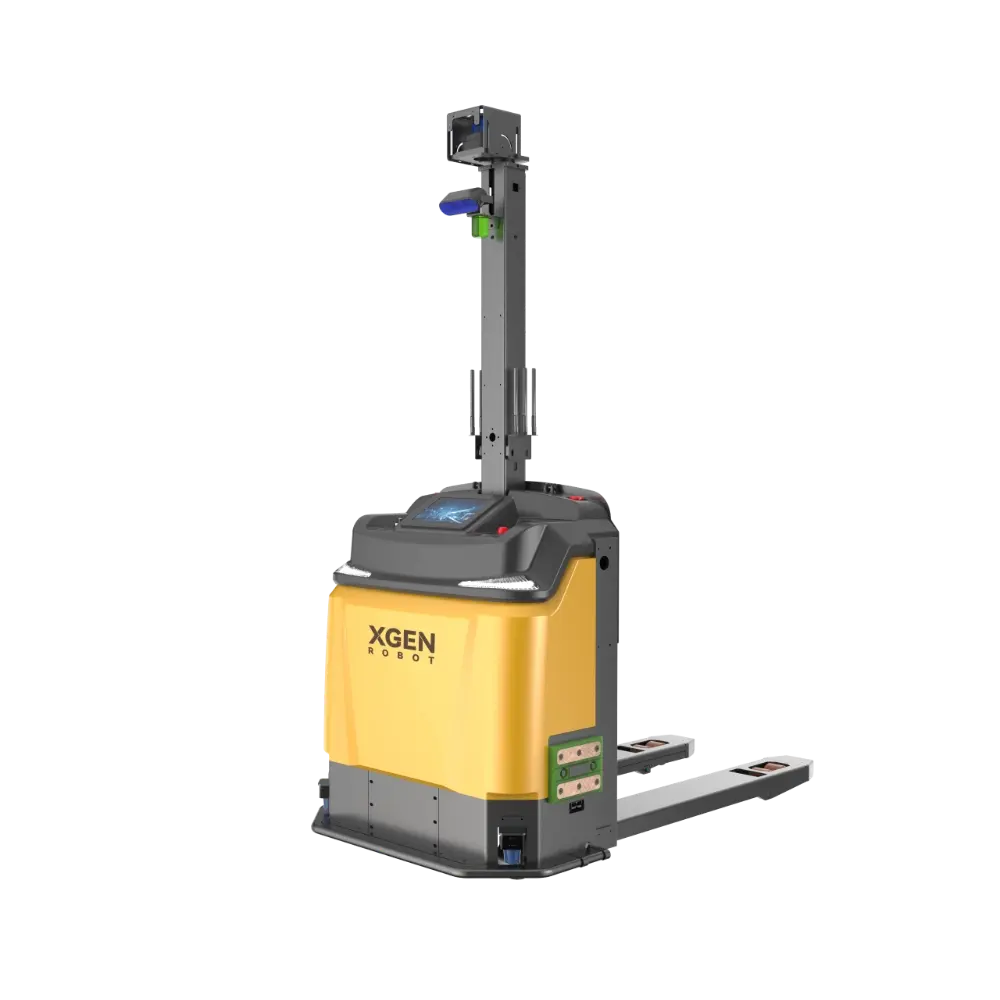
When comparing automated pallet trucks for warehouse operations, request a site-specific assessment covering the following points:
- Load and pallet fit: confirm total weight, load center, fork dimensions, entry direction, pallet condition and load overhang.
- Usable route geometry: check turns, intersections and loaded clearance, not just straight-aisle width. A nominal aisle specification is tied to particular pallet dimensions and clearance assumptions.
- Floor conditions: inspect joints, thresholds, slopes and debris. Low ground clearance makes small obstacles worth investigating before deployment.
- Duty cycle: include pickup, placement, waiting, protective stops and charging when estimating fleet capacity. Maximum travel speed is not average mission speed.
- Safety and acceptance: specify pedestrian interaction, protective functions, recovery procedures and the documentation required for the destination market. Conduct a site-specific risk assessment rather than treating individual sensors as proof of system safety.
Measure changeover improvement before expanding
Start with one repeatable flow, such as returning residual stock and delivering the next replenishment pallet to a packing zone. Record the current time from the last completed batch to the next material-ready state. Separate transport waiting from verification, workstation preparation and other activities.
During the pilot, compare typical and slower changeovers, material-related waiting, first-attempt pickup success and operator interventions. Keep route length, order mix and staffing reasonably comparable. Agree acceptance criteria before testing; do not build a payback calculation around an unverified percentage improvement.
The strongest case for an autonomous pallet truck is a repeatable transport delay that can be removed without creating a new queue elsewhere. If materials arrive earlier but remain unidentified or cannot be accepted by the workstation, the bottleneck has moved rather than disappeared.
FAQ
1. Can one truck handle different SKUs and pallet types?
Different SKUs may share a transport workflow when their pallets, total loads and handling conditions are compatible. Different pallet types require separate validation of fork access, dimensions, underside geometry and recognition performance. Product identification and inventory accuracy also need an agreed process; pallet recognition alone does not verify SKU contents.
2. Do we need WMS integration before starting?
Not necessarily for a limited pilot, provided a suitable mission-release interface is available and the workflow remains controlled. For wider deployment, define how orders, locations, priorities and completion events will be exchanged. Ask the supplier to confirm supported interfaces, integration scope, exception handling and costs rather than assuming a ready-made connection.
3. What should a supplier demonstrate before purchase?
Request trials using your heaviest representative loads, common pallets and difficult transfer points. Include occupied destinations, blocked routes, charging interruptions and safe recovery. Ask for model-specific safety configuration, battery assumptions, service arrangements and measurable acceptance criteria. A successful route demonstration is only one part of proving a reliable changeover workflow.