
Pallet compatibility is one of the first factors to check when selecting an automated pallet handling solution. Even when a mobile robot can navigate warehouse aisles and move loads autonomously, its forks must fit the pallet openings correctly to pick up and transport loads safely.
For buyers evaluating an 自律型パレットスタッカー, the key question is not simply whether the robot can handle pallets. It is whether the pallet dimensions, fork entry points, load characteristics, and warehouse workflows match the robot’s mechanical design.
XGEN Robot’s pallet stacker forklift mobile robot with fixed fork spacing is designed around a fixed-distance fork configuration. This makes pallet consistency an important consideration when assessing whether the equipment fits a warehouse’s material handling requirements.
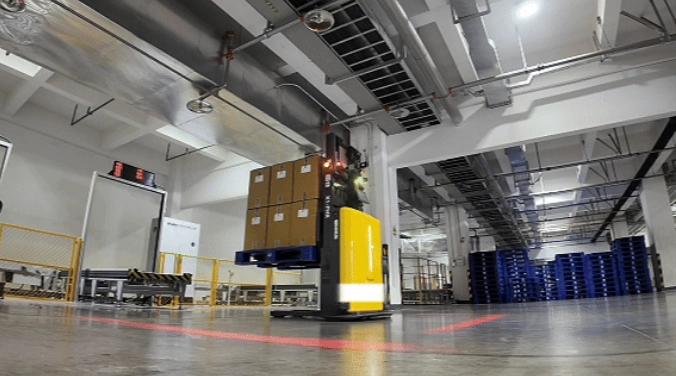
Why Fork Spacing Matters for Pallet Compatibility
Fork spacing determines the distance between the robot’s forks as they approach and lift a pallet. For a successful pickup, the forks must align with the pallet’s openings and provide suitable support for the load.
With fixed fork spacing, the distance between the forks remains constant during operation. The robot does not adjust the spacing to accommodate different pallet widths for each pickup.
This design can work well in warehouses that use standardized pallets across storage, production, and dispatch operations. When pallets share consistent dimensions and fork entry configurations, the robot can follow a more predictable handling process.
However, if a warehouse regularly switches between pallets with substantially different dimensions or opening positions, a fixed configuration may limit flexibility. Buyers should therefore evaluate actual pallet specifications before selecting the equipment.
Which Pallet Types Are Suitable for a Fixed-Fork Autonomous Pallet Stacker?
Standard Euro Pallets
Standard Euro pallets are a practical starting point when evaluating a fixed-fork automated pallet handling solution. A common Euro pallet measures 1,200 × 800 mm, although pallet condition, construction, and entry configuration can vary.
For a warehouse that consistently uses this pallet format, fixed fork spacing may simplify equipment planning because the robot repeatedly handles a relatively uniform load carrier.
Nevertheless, the pallet’s external dimensions alone do not confirm compatibility. Buyers should also check the fork entry direction, opening dimensions, underside structure, and available clearance. The fork spacing and geometry of the selected robot must match the actual pallet design.
Before deployment, confirm these details against the robot’s technical drawings and the pallets used at the facility.
Standardized Pallets With Consistent Dimensions
A fixed-fork 自律型パレットスタッカー can also be a suitable candidate for warehouses using other standardized pallets, provided their dimensions and fork entry arrangements match the robot’s configuration.
For example, a production facility may use the same pallet specification for finished goods moving between packaging, temporary storage, and outbound staging. A distribution operation may also standardize its pallet format across recurring handling tasks.
In these environments, consistency is more important than the pallet’s name alone. The same pallet dimensions, opening positions, and load presentation allow the robot to perform repeatable pickups without needing to accommodate frequent changes in fork spacing.
| Pallet characteristic | Suitability for a fixed-fork design | What to verify |
|---|---|---|
| Standard Euro pallet | A practical candidate | Fork entry direction, openings, and robot compatibility |
| Other standardized pallets | Potentially suitable | Actual dimensions and fork spacing requirements |
| Mixed pallet widths | May be unsuitable | Whether every pallet fits the fixed fork geometry |
| Custom or non-standard pallets | Requires individual assessment | Opening positions, underside structure, and clearance |
| Pallets with variable dimensions | Higher compatibility risk | Dimensional tolerances and consistency between loads |
This table provides a preliminary screening guide, not a guarantee that every pallet in a category is compatible.
When Can Fixed Fork Spacing Become a Limitation?
Warehouses Handling Different Pallet Sizes
Some facilities receive pallets from multiple suppliers. One shipment may use a standard pallet, while another arrives on a wider, narrower, or specially constructed platform.
If the fork entry positions vary significantly, the robot’s fixed spacing may not suit every pallet. A configuration that works for one pallet type could be difficult or unsuitable for another.
Before purchasing, map the pallet types used in daily operations and identify which formats account for most of the handling volume. If several incompatible formats are used regularly, consider whether the operation can standardize pallets or whether equipment with adjustable fork spacing is more appropriate.
Non-Standard and Custom Pallets
Custom pallets are often designed around particular products, packaging dimensions, or load distribution requirements. Their fork openings and underside structures may differ from those of standard pallets.
A fixed-fork robot should not be assumed to handle these pallets simply because their external dimensions appear similar. The forks need sufficient clearance to enter the pallet, and the load must be supported in a suitable position.
For custom pallet applications, request a compatibility assessment using pallet drawings or physical samples. This is especially important when the pallet has unusual openings, reinforced blocks, or a structure that restricts fork access.
Pallets With Dimensional Variations
Even pallets described as the same size may differ because of manufacturing tolerances, wear, damage, or inconsistent construction.
These variations can affect fork entry and positioning. Damaged boards, protruding components, and uneven pallet bases may also interfere with reliable pickup.
A warehouse considering automation should establish basic pallet quality standards alongside robot selection. Standardizing pallet dimensions and removing damaged pallets can help create more predictable handling conditions.
Fixed Fork Spacing vs. Adjustable Forks
The choice between fixed and adjustable fork spacing depends on the variety of pallets in the operation.
| Selection factor | Fixed fork spacing | Adjustable fork spacing |
|---|---|---|
| パレットの寸法 | Best suited to a consistent, compatible format | Can accommodate a broader range if adjustment limits permit |
| Fork configuration | Remains at a set distance | Can change to suit different pallet requirements |
| Operational consistency | Works well with standardized pallets | Offers more flexibility for mixed pallet operations |
| Compatibility checks | Requires matching pallets to the fixed geometry | Requires checking adjustment range and supported configurations |
| Best evaluation priority | Pallet standardization and repeatability | Pallet variety and the need for frequent configuration changes |
Neither configuration is automatically better for every warehouse. A fixed-fork design may be a sensible choice when pallet formats are consistent. An adjustable-fork design may be worth evaluating when multiple incompatible pallet types are a normal part of daily operations.
The decision should be based on the actual pallet inventory, handling frequency, load requirements, and automation workflow rather than on flexibility alone.
What Should Buyers Check Before Deployment?
Before selecting a fixed-fork mobile robot, review the following points with the equipment supplier:
- Pallet dimensions: Record the length, width, and relevant dimensional tolerances of each pallet type.
- Fork entry geometry: Confirm the opening positions, clearance, and entry direction required for pickup.
- Load characteristics: Check the loaded pallet’s weight, dimensions, center of gravity, and stability against the robot’s rated operating limits.
- Pallet consistency: Determine how often non-standard, damaged, or mixed-size pallets enter the workflow.
- Route and handoff conditions: Verify that pickup and drop-off locations provide enough clearance for the robot and its load.
- Representative testing: Test the most common pallet formats and any borderline cases before full deployment.
These checks help distinguish a pallet handling task that fits a fixed-fork design from one that requires a more flexible mechanical configuration.
1 自律型フォークリフト may also be worth evaluating when the wider material handling workflow requires a different lifting configuration or operating arrangement. The appropriate equipment depends on the load, travel route, pickup height, and required handling process.
For operations comparing navigation and automation capabilities as well as mechanical compatibility, a 3D SLAM forklift robot may be another product category to investigate. Navigation technology, however, does not replace the need to verify fork and pallet compatibility.
よくある質問
Can a fixed-fork autonomous pallet stacker handle all Euro pallets?
Not automatically. Euro pallets may share a standard external size, but fork entry geometry, pallet condition, and the robot’s fixed fork configuration still need to be checked.
Is a fixed-fork pallet stacker suitable for mixed pallet sizes?
It depends on whether the different pallets fit the same fixed fork arrangement. If pallet widths, opening positions, or underside structures vary substantially, some formats may be incompatible.
Should buyers standardize pallets before introducing an autonomous pallet stacker?
Where practical, yes. Standardizing pallet dimensions and entry configurations can simplify compatibility checks and make automated handling more predictable. The selected robot must still be validated against the actual pallet specification.
Match the Robot to Your Pallet Requirements
The right pallet handling solution starts with the pallets used in your operation, not just the automation features of the robot. A fixed-fork design is worth considering when pallet dimensions and entry configurations remain consistent. Where pallet formats vary, compatibility testing and alternative fork configurations should be part of the selection process.
Contact XGEN Robot to discuss your pallet specifications and evaluate whether its fixed-fork pallet stacker mobile robot fits your warehouse handling requirements.