
With the continuous increase in warehouse space costs and the growing demand for high-density storage and automated material handling, narrow aisle automated-guided forklifts are becoming an important piece of equipment for warehouse automation upgrades.
Compared with traditional forklifts, automated-guided forklifts can complete pallet handling, stacking, and retrieval in more limited spaces. Combined with automatic navigation, obstacle avoidance, and dispatching systems, they can achieve more stable unmanned operation. However, there are significant differences between warehouses in terms of rack height, aisle width, pallet specifications, and workload. Therefore, choosing the right equipment should not be based solely on rated load capacity or price.
When purchasing a narrow aisle automated-guided forklift, several key factors need to be considered comprehensively.
1. Warehouse Aisle Width
Aisle width is the first parameter that needs to be confirmed when selecting a narrow aisle automated-guided forklift.
The space required by a forklift is not simply its body width. It is also necessary to consider the complete space required for the forklift to enter the aisle, turn, pick up and place pallets, and operate safely. Actual requirements are affected by factors such as forklift structure, pallet dimensions, load overhang, turning radius, and rack layout.
Therefore, before purchasing, the actual clear width between racks should be measured and evaluated together with pallet dimensions and the forklift’s minimum turning radius.
For high-density warehouses, narrower aisles mean that more racks can be arranged within the same building area, thereby improving warehouse space utilization. However, aisle width should not simply be made as narrow as possible. It should ensure that the equipment can complete pallet handling operations safely and reliably.
2. Rated Load Capacity and Actual Load
Rated load capacity is another key parameter when selecting an automated forklift.
Many companies focus only on the equipment’s maximum rated capacity when purchasing, such as 1.5 tons, 2 tons, or 2.5 tons. However, actual operating capacity is also related to lifting height, load center distance, load dimensions, and fork configuration.
Especially when operating with high-level racks, the actual residual load capacity of the forklift may change as the lifting height increases. Therefore, the equipment should not be selected solely according to its maximum rated load capacity. Instead, it is necessary to confirm how much weight the equipment can actually handle at the required working height.
3. Maximum Lifting Height
Rack height directly determines the lifting height that the forklift needs to achieve.
Before selecting equipment, it is necessary to determine the height of the highest storage position in the warehouse, the distance between each rack level, and the safety clearance required when the pallet enters the storage position. At the same time, the height of the forklift with the mast lowered also needs to be considered to ensure that the equipment can pass smoothly through warehouse doors, aisles, and other areas with limited overhead clearance.
For high-bay storage projects, it is also necessary to pay attention to the residual load capacity of the forklift at different lifting heights.
4. Pallet Dimensions and Load Characteristics
Pallets are not completely standardized products. Different companies may use pallets of different sizes, materials, and structures, while the length, width, height, and center of gravity of the load can also affect forklift operating requirements.
If the forklift’s design parameters do not match the actual pallets, the equipment may be able to enter the aisle but still experience problems with handling stability and positioning accuracy.
5. Navigation Technology
One of the biggest differences between automated-guided forklifts and traditional forklifts is their ability to achieve unmanned movement through automatic navigation systems.
Currently, automated forklifts can use various navigation methods, including Laser SLAM, QR codes, and magnetic navigation. Different navigation methods also have different requirements for warehouse infrastructure, path planning, and subsequent adjustments.
For example, Laser SLAM navigation generally offers good environmental adaptability and does not require large amounts of fixed magnetic strips or other infrastructure to be installed on the floor. Therefore, it is more suitable for automation projects that require flexible warehouse layout adjustments. XGEN Robot’s automated forklift products also use navigation technologies such as 3D Laser SLAM to achieve high-precision positioning and autonomous movement.
When selecting a navigation solution, it is necessary to consider not only navigation accuracy but also the warehouse environment, rack layout, floor conditions, dynamic obstacles, and the possibility of future warehouse expansion.
6. Safety Features
Although automated forklifts can reduce the need for manual driving, this does not mean that safety systems can be ignored.
In actual warehouse environments, automated forklifts may operate simultaneously with personnel, other forklifts, AGVs, AMRs, and goods. Therefore, the equipment needs to have comprehensive environmental perception and safety protection capabilities.
Especially in narrow aisle environments, positioning accuracy and obstacle detection capabilities are even more important because the space available for equipment adjustment is usually more limited.
7. Battery and Charging Method
Automated forklifts usually need to operate continuously for long periods, so battery capacity and charging methods can also directly affect overall warehouse efficiency.
During the purchasing process, the appropriate battery system should be selected based on daily operating hours, number of shifts, average handling distance, and equipment workload.
For automated warehouses that require long periods of continuous operation, a reasonable charging strategy can reduce equipment downtime and improve overall equipment utilization.
8. Do Not Only Consider Storage Density; Consider Throughput as Well
One of the major advantages of narrow aisle forklifts is their ability to reduce aisle space and improve warehouse storage density.
However, storage density is not the only factor that needs to be considered when selecting equipment.
If a warehouse needs to handle a large number of pallets every day, equipment operating speed, pallet handling efficiency, task dispatching capabilities, and multi-vehicle coordination are equally important.
For example, a forklift that can operate in extremely narrow aisles may still fail to significantly improve overall warehouse throughput if each task takes too long or if there is no effective coordination with other warehouse equipment.
Therefore, during the purchasing process, the actual daily pallet handling volume should be calculated, and the equipment should be evaluated to determine whether it can meet peak operating requirements.
9. WMS/WCS System Integration Capability
For an automated warehouse, the forklift itself is only one part of the overall system.
If a company is already using a WMS (Warehouse Management System) or WCS (Warehouse Control System), it is necessary to confirm whether the automated-guided forklift can exchange data with the existing system.
Ideally, the system should enable automatic coordination from order release and inventory management to material handling task execution. For example, after the WMS generates an inbound task, the system sends the task to the WCS, and the dispatching system then assigns it to a suitable automated forklift to complete pallet handling.
Therefore, during the purchasing stage, it is necessary to confirm in advance whether the equipment supports standard communication interfaces and whether it can be integrated with the existing warehouse management system.
10. Total Cost of Ownership (TCO)
When purchasing automated forklifts, the equipment price is only part of the total cost.
Companies also need to consider installation and deployment, software systems, commissioning, maintenance, battery replacement, spare parts, and ongoing technical support.
Therefore, instead of simply comparing the purchase prices of different brands, it is better to evaluate the equipment based on its long-term operating costs.
For warehouses that operate over a long period, a lower initial purchase price does not necessarily mean the lowest final cost. Stability, ease of maintenance, and system scalability can also affect the return on investment.
11. Future Scalability
Warehouse automation is usually not completed through a one-time upgrade.
As order volumes increase, warehouse layouts change, or business scales up, companies may need to add more automated forklifts, expand into new rack areas, or coordinate automated forklifts with AMRs, conveyors, stacker cranes, and other equipment.
Therefore, when selecting a narrow aisle automated-guided forklift, future system scalability should also be considered.
For example, does the equipment support multi-vehicle coordination? Can new operating areas be added? Can the navigation system adapt to changes in warehouse layout? Can the control system connect to additional automation equipment?
An automation solution with good scalability can reduce costs and system modification pressure when companies carry out secondary upgrades in the future.
How to Choose the Right Narrow Aisle Automated-Guided Forklift?
There is no single automated forklift that can be used for every warehouse.
The right equipment selection depends on multiple factors, including aisle width, pallet dimensions, load capacity, lifting height, navigation requirements, safety conditions, operating time, throughput, and system integration capabilities.
For conventional narrow aisle pallet handling, XGEN 로봇‘s 좁은 통로용 스태커 FMR has a maximum load capacity of up to 2 tons and a maximum lifting height of up to 3.5 meters; for ultra-narrow aisle storage, the multi-directional X1-MN10 has a compact body width of 953 mm, with a theoretical aisle width of 1,758 mm under specific pallet conditions; while for high-level storage, XGEN 로봇‘s Reach Truck and heavy-duty FMR solutions can cover applications requiring greater lifting heights and heavier load capacities.
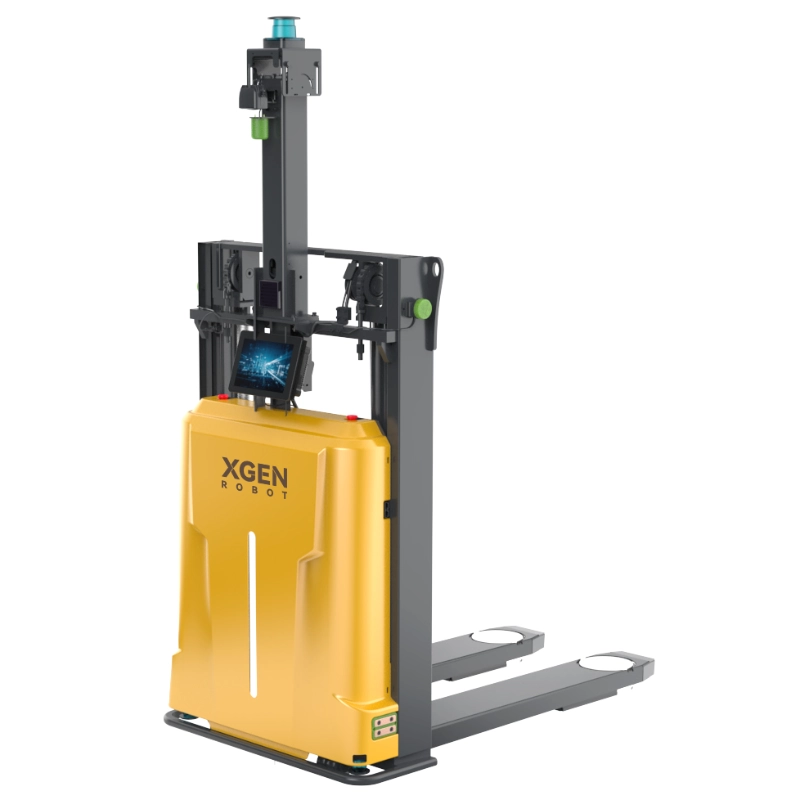
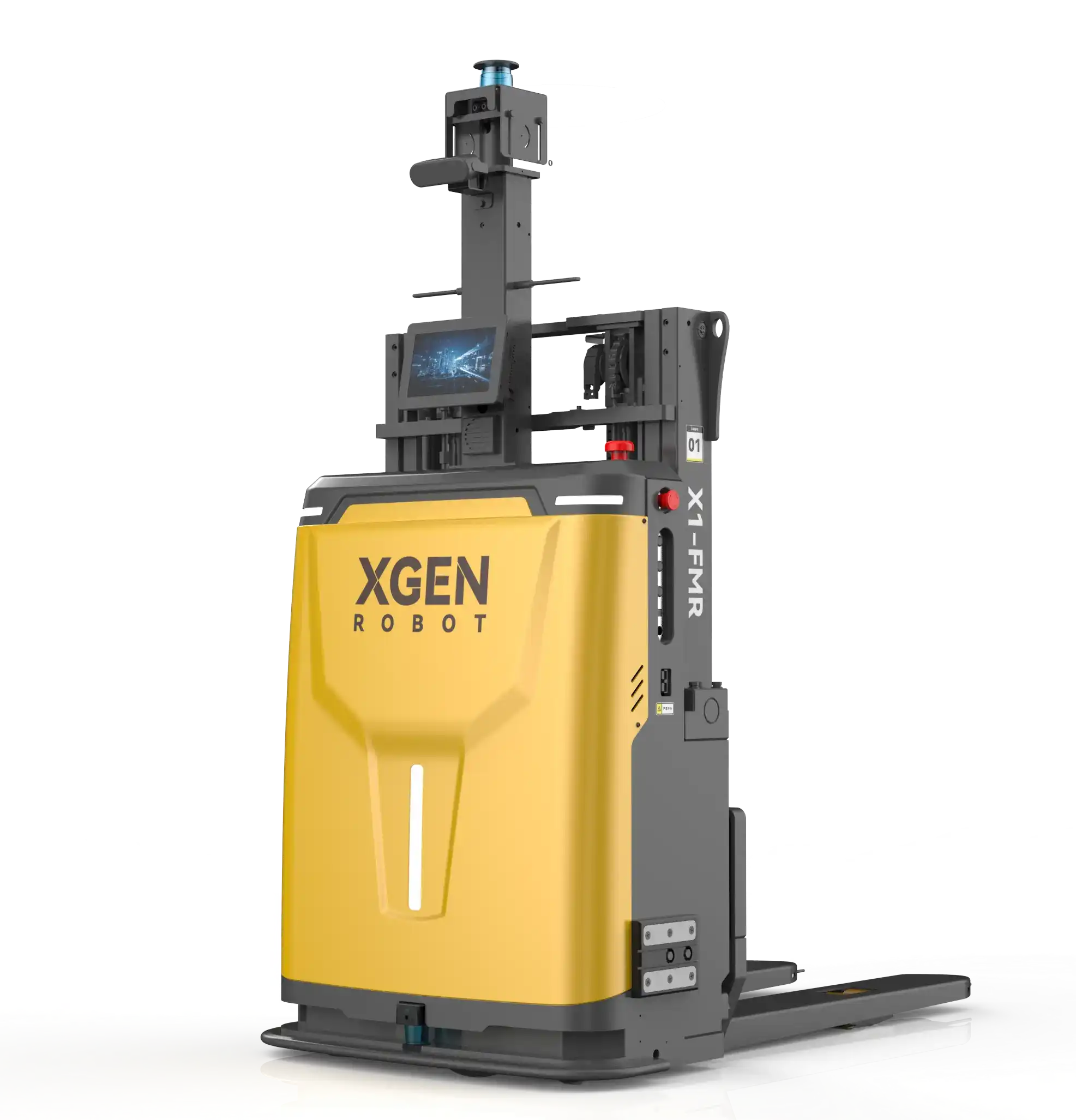
Therefore, the most effective way to select equipment is not to determine a specific forklift model first, but to start with the actual warehouse requirements.
By matching equipment configurations with warehouse layouts, pallet specifications, and actual material flows, companies can further improve storage space utilization, reduce manual handling, and build a more flexible and scalable automated warehousing system.
If you are evaluating an automated-guided forklift for a narrow aisle warehouse, XGEN 로봇 can provide customized FMR solutions based on your aisle dimensions, pallet specifications, storage height, load requirements, and warehouse automation processes.