
Table of Contents
In today’s fast-evolving world of smart manufacturing and warehouse logistics, Autonomous Mobile Robots (AMRs) are becoming an essential tool for improving material handling efficiency, reducing labor costs, and enabling flexible automation. Unlike traditional fixed-path systems, AMRs use environmental perception, autonomous navigation, and dynamic obstacle avoidance to complete material transport tasks with greater flexibility in complex and open working environments.
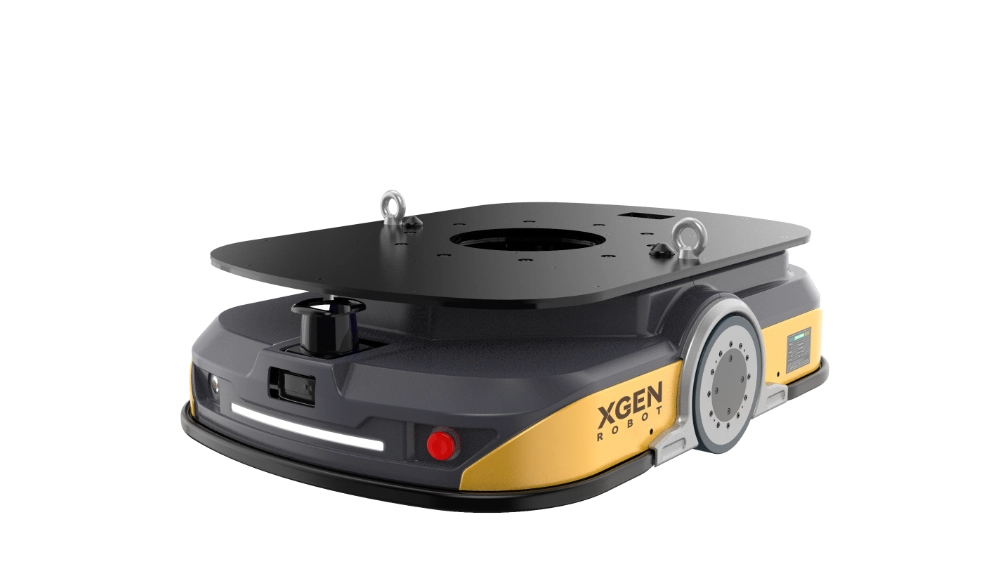
This article provides a comprehensive overview of how AMRs work, their advantages, application scenarios, and future development trends.
What Is an AMR?
AMR stands for Autonomous Mobile Robot. It refers to an intelligent robot that can move autonomously, identify routes, and complete logistics tasks in complex environments by using advanced sensors, artificial intelligence algorithms, and navigation technologies.
Compared with traditional handling equipment, AMR robots can perceive their surroundings in real time, plan optimal paths according to task requirements, and dynamically avoid obstacles.
How Do AMRs Work?
The working logic of an AMR can be understood as three steps: perception, decision-making, and execution. It relies on multiple intelligent technologies working together to achieve autonomous navigation and task execution.
1. Intelligent Navigation System
AMRs typically use:
- LiDAR
- Vision sensors
- Depth cameras
- SLAM navigation technology
By scanning the environment in real time, the robot can build maps and accurately locate itself.
2. AI Path Planning
AMR robots use intelligent algorithms to analyze:
- Current tasks
- Environmental changes
- Traffic conditions
- Obstacle locations
Based on these factors, they automatically plan the best movement route.
3. Automatic Task Execution
AMR systems can connect with:
- WMS (Warehouse Management System)
- MES (Manufacturing Execution System)
- ERP systems
Based on production and warehouse requirements, the system automatically receives tasks and enables:
- Automatic pickup
- Automatic transport
- Automatic delivery
- Automatic return to charging
This helps enterprises build a more intelligent logistics workflow.
What Is the Difference Between AMR and AGV?
When selecting automation equipment, many companies compare AMRs and AGVs. Although both are used for automatic material handling, their technical characteristics differ significantly.
| Comparison Item | AMR | AGV |
| Navigation Method | SLAM-based autonomous navigation | Magnetic strips, tracks, QR codes |
| Path Planning | Automatic route planning | Fixed routes |
| Environmental Adaptability | High | Lower |
| Deployment Cost | Flexible and fast | Higher modification requirements |
| Scalability | Strong | Limited |
| Suitable Scenarios | Dynamic warehouses, smart manufacturing | Fixed logistics routes |
Main Advantages of AMRs
What makes AMRs so unique and attractive to businesses of all sizes? Their value lies in their ability to improve efficiency while supporting more flexible and intelligent internal logistics.
1. Improved Productivity and Efficiency
AMRs can efficiently handle routine transport tasks and support long hours of continuous operation, significantly improving overall productivity. By continuously collecting and analyzing operational data, the system can also optimize routes and dispatch strategies, reduce waiting time, avoid bottlenecks, and keep logistics flowing smoothly.
2. Greater Flexibility and Adaptability
Compared with traditional automation equipment, AMRs are more adaptable to on-site changes. They do not require major infrastructure modifications and can quickly adjust to new tasks, workflows, and operating areas. Companies can also add stations, change routes, or expand to new application scenarios based on actual needs.
3. Reduced Human Error and Better Cost Efficiency
By automating repetitive and standardized transport tasks, AMRs can effectively reduce labor costs and minimize mistakes and material losses caused by manual operations. More importantly, they free employees from heavy handling work and allow them to focus on higher-value tasks, improving overall operational efficiency. For many companies, this type of investment can generate returns within a relatively short period.
4. Strong Scalability
AMR systems can integrate smoothly into existing production and warehouse environments and scale up as the business grows. Companies can increase the number of robots according to business demand or redeploy them to other workstations and scenarios when needs change. This scalability makes AMRs especially suitable for growing businesses and multi-scenario operations.
Main Application Scenarios of AMRs
AMRs are now widely used in manufacturing, warehousing, electronics assembly, pharmaceuticals, automotive parts, and e-commerce sorting. They can be used not only for material transport, but also for loading and unloading, process transfer, inventory replenishment, and production line delivery.
Common applications include:
- Material transfer from the production line to the warehouse
- Pallet handling in warehouse centers
- Multi-station transport inside workshops
- Automation of logistics through integration with WMS, MES, and ERP systems
Why Are More Companies Choosing AMRs?
As labor costs continue to rise, orders become more fragmented, and production cycles accelerate, traditional manual handling methods are becoming less able to meet the efficiency demands of modern factories. AMRs help companies reduce repetitive transport work, minimize human error, and improve overall logistics response speed.
In addition, AMRs also improve workplace safety. Equipped with obstacle avoidance and real-time sensing capabilities, they can operate more reliably in environments where people and equipment work side by side, reducing the risk of collisions. This is one of the main reasons why many manufacturing and warehousing companies are accelerating AMR deployment.
How to Choose the Right AMR
When selecting an AMR, companies should focus on the following key factors:
- Load capacity, whether it matches the actual handling task
- Navigation method, whether it suits the site environment
- Battery life, whether it supports continuous operation
- Safety features, including obstacle avoidance, emergency stop, and anti-collision protection
- System compatibility, whether it can connect with existing WMS, MES, and other systems
If the site environment changes frequently and task types are diverse, companies are usually better off choosing an AMR solution with strong scalability and flexible scheduling capabilities.
XGEN ROBOT: Your Smart Logistics Automation Partner
As a professional smart logistics robot supplier, XGEN ROBOT is committed to providing global enterprises with advanced Autonomous Mobile Robots (AMRs) and intelligent material handling solutions.
With advanced navigation technology, intelligent control systems, and flexible deployment capabilities, XGEN ROBOT helps manufacturing companies, warehouse centers, and logistics businesses improve automation levels and achieve more efficient, safer, and smarter logistics operations.
Whether for warehouse handling, production line delivery, or complex industrial scenarios, XGEN ROBOT can provide automation solutions tailored to business needs.
Conclusion
Autonomous Mobile Robots are redefining how modern factories and warehouse logistics operate. With autonomous navigation, real-time perception, and dynamic obstacle avoidance, AMRs help businesses achieve more flexible, efficient, and safer automated material handling. For enterprises pursuing smart upgrades, AMRs are no longer just a trend — they are a practical and deployable solution.