
With the continuous development of smart logistics and industrial automation, more and more companies are replacing traditional manual handling with automated equipment to improve efficiency, reduce costs, and lower safety risks. With stable load capacity, flexible handling methods, and strong scenario adaptability, counterbalanced AGVs have become a very practical unmanned handling solution in factories and warehouses.
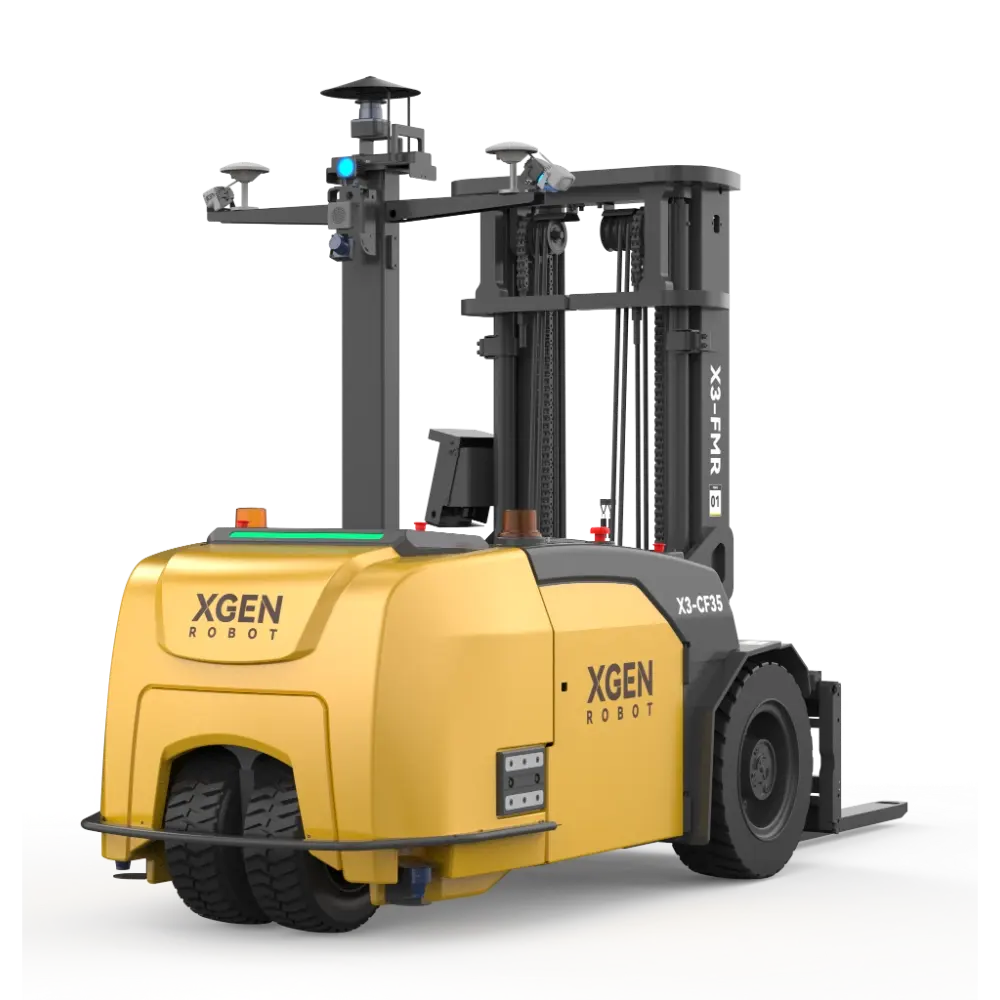
Compared with ordinary handling equipment, counterbalanced AGVs are better suited for palletized goods, heavy materials, and high-frequency transfer tasks. For companies that want to optimize internal logistics, reduce forklift dependence, and improve automation levels, this is a solution worth serious consideration.
Table of Contents
Which Industries Are Counterbalanced AGVs Suitable For
1. Warehousing and Logistics
Warehousing and logistics is one of the most common application areas for counterbalanced AGVs. Whether it is inbound raw materials, outbound finished goods, or internal warehouse transfer and ground-level handling, counterbalanced AGVs can perform very well.
In warehouses with frequent turnover, a wide variety of pallets, and highly repetitive handling tasks, this type of equipment can effectively reduce repeated forklift operation and improve overall logistics flow, helping companies achieve more stable warehouse management.
2. Manufacturing Plants
Manufacturing places very high demands on the timeliness and accuracy of material delivery. Counterbalanced AGVs can be used for line-side material supply, semi-finished product transfer, inter-process delivery, and finished goods storage.
For industries such as auto parts, machining, home appliances, and electronics manufacturing, counterbalanced AGVs help factories reduce manual handling errors, making material flow more standardized and easier to match with production rhythm.
3. Steel and Heavy Industry
Steel, metal processing, and heavy machinery industries often face large loads, long transportation distances, and complex operating environments. Counterbalanced AGVs have strong practical value in these scenarios.
They can be used for handling steel, heavy pallets, metal components, and large workpieces, helping companies improve heavy-load transfer efficiency while reducing safety risks and labor intensity during manual handling.
4. Paper, Packaging, and Printing
Paper, packaging, and printing industries often deal with large volumes, varying weights, and frequent transfers. Counterbalanced AGVs can be used for paper roll handling, finished packaging transport, raw paper storage, and semi-finished product transfer.
These industries usually operate at a fast pace. With counterbalanced AGVs, companies can reduce waiting time and unnecessary handling, making material delivery smoother and improving overall production efficiency.
5. Chemical, Food, and Pharmaceutical Industries
In chemical, food, and pharmaceutical industries, safety and compliance are just as important as handling efficiency. Counterbalanced AGVs can take over pallet handling and material delivery in standardized logistics workflows.
For companies that need to reduce direct human contact, lower forklift operation risks, and improve cleanliness and safety management, counterbalanced AGVs are a highly suitable automated handling solution.
6. Indoor-Outdoor Transfer and Cross-Zone Transport
Some counterbalanced AGVs are also suitable for indoor-outdoor transfer scenarios, such as short-distance transport between workshops and warehouses, loading dock transfer, and temporary storage area handling.
XGEN ROBOT already has real-world project experience in this type of application. For example, in an indoor-outdoor material transfer project, the equipment was used to connect the warehouse and the production line, enabling continuous material movement between different zones and helping the company maintain stable and uninterrupted material flow. This application is especially suitable for factories that require cross-zone logistics coordination.
Common Application Scenarios
Counterbalanced AGVs are widely used, especially for tasks such as:
- Raw material inbound
- Production line supply
- Semi-finished product transfer
- Finished goods outbound
- Pallet handling
- Automatic loading and unloading
- Short-distance warehouse transfer
- Heavy material movement
These scenarios all share one common trait: handling tasks are highly repetitive and process standards are strong, making them ideal for automation to replace manual work.
Industry Case Reference
In the beverage industry, XGEN ROBOT has provided warehouse automation solutions for one of the largest beverage manufacturers. In this project, counterbalanced FMRs were used for high-frequency pallet transport, double stacking, and continuous transfer between the production area and the warehouse, helping the customer maintain higher efficiency and more stable operation in a high-speed working environment.
This case shows that counterbalanced AGVs are not just handling tools. They are an important part of helping companies optimize internal logistics and improve automation levels. For companies with large volumes of pallet handling, heavy-load transfer, and cross-zone logistics needs, their value is highly significant.
Why More Companies Are Choosing Counterbalanced AGVs
Companies usually choose counterbalanced AGVs not only to achieve automation, but also to solve real logistics problems related to efficiency, cost, and safety.
First, they improve handling efficiency and reduce the time lost to repeated forklift operations. Second, they lower human error and make logistics processes more stable. In heavy-load or high-frequency handling scenarios, counterbalanced AGVs can also reduce employee labor intensity and improve the overall working environment.
For companies building smart factories and intelligent warehouses, this type of equipment is not just a handling tool, but a key part of logistics automation upgrade.
What XGEN ROBOT Can Provide
As a company focused on intelligent logistics equipment and automated handling solutions, XGEN ROBOT is committed to providing handling solutions better suited to real operating conditions. We focus not only on equipment performance, but also on scenario matching, system integration, and long-term operational stability.
For different customer handling needs, XGEN ROBOT can provide more flexible counterbalanced AGV solutions, helping companies achieve more efficient automated handling in warehousing, manufacturing, and heavy industry scenarios.
Conclusion
Counterbalanced AGVs are suitable for a wide range of industries, especially warehousing and logistics, manufacturing, steel and heavy industry, paper and packaging, chemical, food, pharmaceutical, and indoor-outdoor transfer applications. For companies with pallet handling, heavy-load transport, and high-frequency transfer requirements, they can effectively improve efficiency, reduce costs, and drive logistics systems toward greater intelligence.
If a company wants to achieve a higher level of automation in its handling processes, counterbalanced AGVs are certainly a solution worth exploring and deploying.