
Table of Contents
When warehouses start automating pallet movement, the choice usually narrows to two robot families: forklift mobile robots (FMR) and flat-bed autonomous mobile robots (AMR). They look like competitors, but they solve different problems. For pallet stacking and high-rack storage, the ROI comparison depends less on the price tag than on one question: does the robot need to lift loads and place them at height?
The short answer is that if pallets must go into racking or be stacked in layers, an FMR usually delivers the better return, because it automates the entire load path. If the job is mostly horizontal transport between fixed points, a flat-bed AMR is often the cheaper and simpler investment.
What Is the Difference Between an FMR and a Flat-Bed AMR?
A flat-bed AMR is a low, platform-style robot that carries a pallet, cart or shelf across the floor. Some models add a conveyor top or a small lifting module. It is excellent at point-to-point transport, but it is not designed to lift a pallet into a rack.
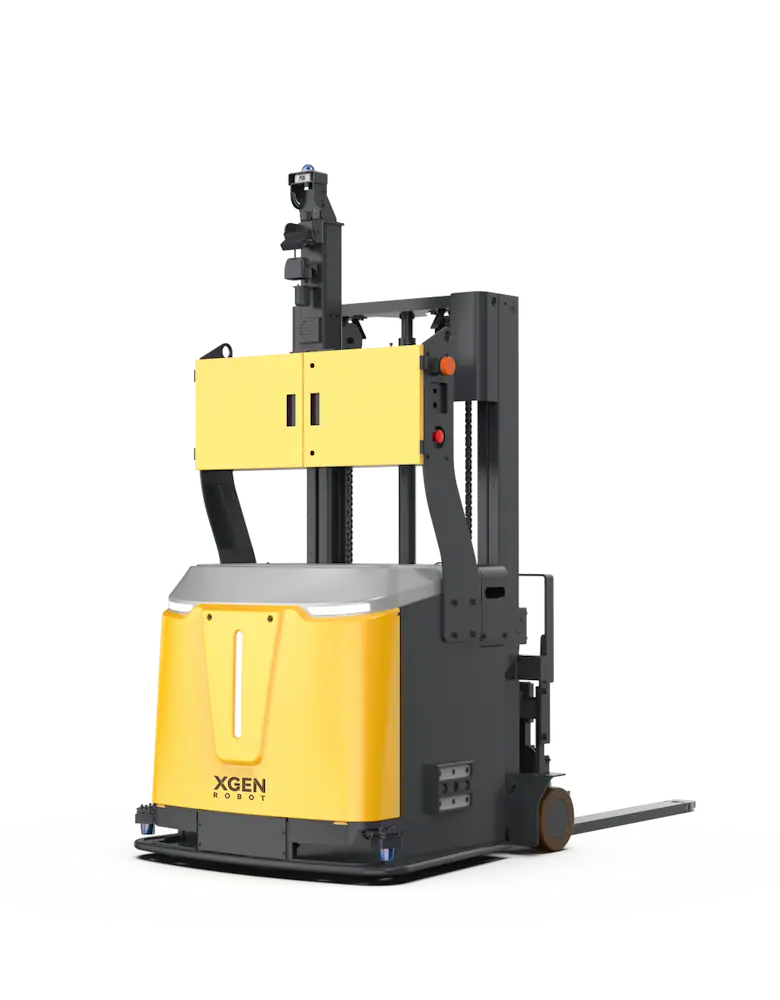
An FMR is essentially an autonomous forklift. It has a mast and forks, and it uses onboard sensors and navigation software to pick, lift, stack and place pallets at height. FMRs come in the same families as manual forklifts: counterbalanced, reach truck, pallet stacker and very narrow aisle (VNA).
| Factor | Flat-bed AMR | FMR (forklift mobile robot) |
|---|---|---|
| Core function | Horizontal transport at or near floor level | Transport plus lifting, stacking and rack put-away |
| Pallet placement in racking | Generally not possible | Core capability |
| Extra equipment needed for rack work | Usually a manual forklift or stacker | Typically none |
| Aisle width | Flexible, as the robot is low and compact | Depends on the type, from wide to very narrow |
| Upfront cost per unit | Usually lower | Usually higher |
| Best fit | Line feeding, staging, conveyor-to-conveyor moves | Pallet stacking, high-rack storage, dock-to-rack flows |
Why Pallet Stacking and High-Rack Storage Change the ROI Equation
A flat-bed AMR can show a strong return on transport labor. But if every pallet still needs a human forklift operator for the vertical step, the saving is only partial. You have automated the move but not the lift, and you still carry the cost of operators, training and safety procedures.
Each handoff also adds a floor drop zone. That zone takes space, adds waiting time and creates another chance for pallet damage or a mis-scan.
Vertical storage is where warehouse space pays back. Going higher and narrower raises the number of pallet positions per square meter, but only a machine that can lift accurately and verify rack positions can use that space. An FMR automates the full cycle from pickup to rack slot, so the labor, space and error savings add up in one system.
Matching the FMR Type to the Job
An FMR is not one machine. Each type suits a different storage layout, and picking the wrong one can erase the ROI advantage.
Floor-level stacking, docks and line-side transfers
For floor stacking, dock-adjacent transfers and line-side supply, a counterbalanced automated guided forklift FMR is usually the most direct fit. It handles heavier loads and mixed floor conditions well. The trade-off is that it needs wider aisles, since it must turn with the load.
High-rack storage in narrow aisles
When pallets go into racking, a moving mast reach truck FMR is the common choice. The mast moves forward into the rack while the truck stays stable, which lets it work in narrower aisles than a counterbalanced truck. Reach-type FMRs typically need aisles of roughly 2.7 to 3.2 m, depending on pallet size and load. Smaller reach models are worth a look when floor space is tight or the building is an older one.
Maximum density in very narrow aisles
For the highest storage density, a 3-way VNA forklift mobile robot works in aisles of roughly 1.6 to 2.0 m. Its fork head pivots to the side, so the truck does not have to turn inside the aisle. It can also serve taller racking than most reach trucks. The trade-offs are a higher purchase cost, tighter floor flatness requirements and a more rigid rack and aisle design.
Breaking Down the ROI: Where the Costs and Savings Sit
A fair comparison looks at the cost per pallet moved and placed, not the cost per robot. These are the main drivers:
- Investment: robot, fleet software, WMS integration, site mapping, safety systems, and any floor or rack adjustments.
- Labor savings: fewer operators per shift, and the ability to run extra shifts without extra headcount.
- Space value: more pallet positions from the same footprint, which matters most when expansion is expensive.
- Damage and safety: fewer rack collisions and pallet drops, and lower exposure to forklift incidents.
- Ongoing costs: maintenance, battery replacement, charging, software fees and periodic safety checks.
The simple payback formula is net investment divided by annual net savings. A flat-bed AMR with a lower price can still lose this comparison if each put-away needs a manual forklift to finish the job.
When a Flat-Bed AMR Is Still the Better Investment
A flat-bed AMR is often the smarter choice in these cases:
- Pallets or carts move between production, staging and shipping at floor level.
- Storage is low-bay or block-stacked, with no high racking.
- Loads are light, or the main job is feeding lines and conveyors.
- Budget is limited and a quick, low-risk first phase is needed.
Many sites also combine both. Flat-bed AMRs handle horizontal transport, while FMRs handle stacking and rack put-away.
A Practical Checklist Before You Decide
- Map the load path. Count every step where a pallet must go above floor level.
- Measure aisles and racks. Record aisle width, rack height and pallet dimensions.
- Check the route. Look at floor flatness, ramps, elevators and door widths.
- Estimate throughput. Count pallets per hour and shifts per day.
- Pilot one zone. Run one lane or area first and measure the cost per pallet before scaling.
FAQ
Can a flat-bed AMR stack pallets in racking?
Generally no. Most flat-bed AMRs move loads at or near floor level. Placing pallets in racks requires a forklift-type machine such as an FMR, or a separate lifting device.
Is an FMR always more expensive than a flat-bed AMR?
The unit price is usually higher, but the total return can be better when the FMR removes manual forklift work, extra handoff zones and wasted floor space.
How narrow can the aisles be for an FMR?
It depends on the type. Counterbalanced FMRs need the widest aisles, reach-type FMRs work in narrower ones, and 3-way VNA designs need the least, roughly 1.6 to 2.0 m.
Can FMRs and flat-bed AMRs work together?
Yes. A common setup uses flat-bed AMRs for horizontal transport and FMRs for stacking and rack put-away, managed by the same fleet system.
Start With the Load Path, Not the Robot
The best choice follows from what happens to each pallet. If it only travels across the floor, a flat-bed AMR is often enough. If it must be lifted, stacked or stored high, an FMR is more likely to deliver a lasting return, and the right FMR type depends on aisle width, rack height and load weight.
XGEN Robot develops forklift mobile robots across the categories discussed here, including counterbalanced, reach truck, narrow-aisle and pallet stacker models. Teams comparing options can use the framework above to prepare their own load-path and aisle data before speaking with any vendor.