
Table of Contents
A pallet that works with a manually operated forklift is not automatically ready for autonomous handling. Before deploying an autonomous pallet stacker, check the complete interface: pallet construction, fork openings, load distribution, support-leg clearance, pickup position, and the destination where the load will be placed.
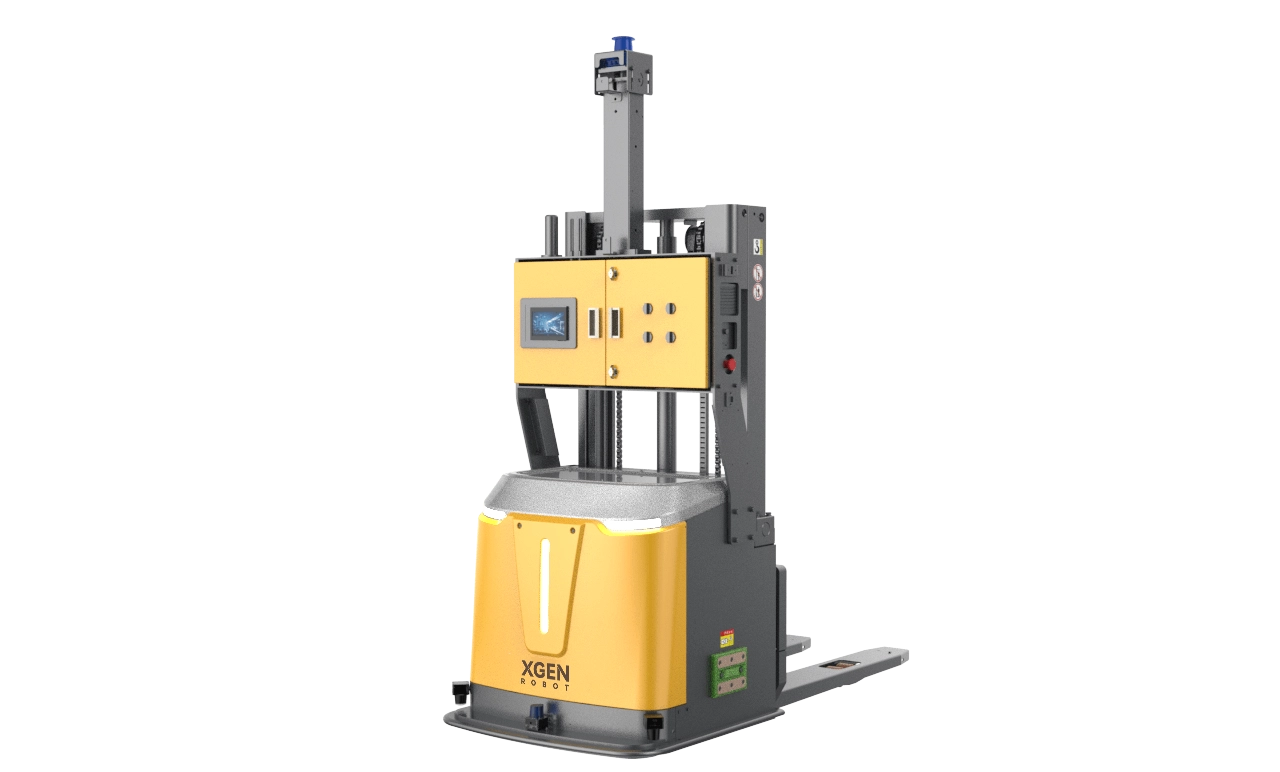
For XGEN Robot’s X1-PS15, these checks are particularly relevant because the machine uses fixed fork spacing and front straddle legs. XGEN describes it as suitable for loading, unloading, and transferring standard single-deck pallets. Compatibility should therefore be assessed against the selected vehicle configuration—not assumed from the pallet’s outside dimensions alone.
What Makes a Pallet Compatible with Automated Handling?
Compatibility means the vehicle can approach, insert its forks, lift, transport, and place the pallet under defined operating conditions. A successful pickup is only one part of that sequence.
Start by preparing a record for every pallet type in circulation. Include its external dimensions, material, underside construction, permitted entry directions, opening dimensions, and maximum loaded weight. Photograph both the top and underside, with close-ups of the intended fork-entry side.
Do not group different pallets together simply because they share a nominal footprint. Different bottom boards, blocks, runners, or repairs can change the available space for forks and support legs.
How Do You Check Fork Openings and Support-Leg Clearance?
Match the pallet openings to the actual fork geometry
The X1-PS15 specification lists forks measuring 1,170 × 180 × 65 mm. It also lists outside fork spacing options of 670/570 mm and inside spacing options of 310/210 mm. Confirm the supplied configuration with XGEN rather than interpreting these alternatives as automatic fork-width adjustment.
Measure the usable height and width of each opening, the distance between openings, and the available insertion depth. Include internal obstructions rather than measuring only the visible entrance.
A fork opening that appears large enough on an unloaded pallet may behave differently when the pallet is carrying its working load. Include loaded samples in the assessment and agree the required clearance with the equipment supplier.
Check the underside, not just the fork pockets
The front straddle legs introduce another interface to verify. Bottom boards, closed pallet bases, station frames, and floor-level obstructions may interfere with the vehicle even when its forks align with the openings.
Ask XGEN to review underside drawings and loaded pallet samples. If the pallet structure conflicts with the selected vehicle, resolve the mismatch before deployment through an approved pallet, station, or vehicle arrangement.
How Should You Verify Load Weight, Load Center, and Lifting Height?
XGEN’s Pallet Stacker Forklift Mobile Robot with Fixed Fork Spacing is listed with a 1,500 kg load capacity and a 600 mm load center distance. Its standard lifting height is 2,500 mm, with listed alternatives extending to 4,500 mm.
Treat these as configuration inputs, not a promise that every 1,500 kg load can be lifted to every listed height. Ask XGEN to confirm the permitted load for the actual load center, selected mast, and target placement height.
Record the full transported weight, including the pallet and packaging. Identify unevenly distributed products, off-center loads, overhanging cartons, and any goods that may move during travel.
For each load family, provide the maximum dimensions, normal and maximum weight, expected center-of-gravity position, and required lifting height. This gives the supplier a more useful engineering basis than a single maximum-weight figure.
What Pallet Condition and Placement Variations Should You Test?
Define which pallets are acceptable
Create a receiving and inspection rule for broken boards, protruding fasteners, missing blocks, excessive deformation, and loose wrapping around the fork-entry area. Agree rejection criteria with the responsible engineering and safety teams.
Testing should cover the variation present in normal production, but visibly unsafe pallets should be removed rather than used to demonstrate the robot’s tolerance.
Separate vehicle positioning from pallet detection
XGEN lists vehicle positioning accuracy of ±10 mm and lifting height accuracy of ±5 mm for the X1-PS15. These figures should not be presented as the permissible pallet misalignment or a guaranteed fork-insertion tolerance.
The technical table lists fork-tip photoelectric detection as standard, while pallet identification and pallet in-position detection are optional. Confirm the detection package in the project quotation, together with its validated operating limits. Do not assume that every robotic pallet stacker configuration includes the same sensing functions.
Define what happens when a pallet falls outside the agreed position or condition limits: stop the task, notify an operator, correct the pallet, and restart using the approved procedure. Autonomous operation needs a clear exception workflow as well as a normal workflow.
How Do Pickup and Drop-Off Stations Affect Compatibility?
A compatible pallet can still be unsuitable for a particular station. Review the space available for approach, turning, fork insertion, support-leg movement, lifting, and withdrawal at both ends of the task.
For reference, XGEN lists a 962 mm body width and a 1,734 mm minimum turning radius for the X1-PS15. Its listed aisle widths are 2,695 mm and 2,660 mm for specified orientations of a 1,000 × 1,200 mm pallet, using a stated 200 mm clearance condition. These are reference configurations, not universal minimum aisle requirements.
Provide drawings showing rack uprights, conveyors, guards, nearby equipment, floor transitions, and overhead restrictions. Validate the loaded vehicle’s complete movement at each station instead of relying only on vehicle width or turning radius.
How Can You Validate Compatibility Before Deployment?
Use representative loaded pallets and the proposed vehicle configuration. Agree the test conditions and acceptance criteria before running the trial.
- Verify approach and fork insertion from the intended entry direction.
- Check lifting and withdrawal without unintended pallet or station contact.
- Test travel and turning with the actual load envelope.
- Confirm placement and fork withdrawal at the required destination height.
- Test approved placement variations and document when operator intervention is required.
- Record failures, contact events, pallet damage, and recovery steps—not only completed tasks.
Repeat testing across the agreed pallet and load combinations. Changes to pallet suppliers, packaging, load distribution, or station geometry should trigger a review of the affected compatibility checks.
What Should You Send XGEN for a Compatibility Review?
Prepare a compact engineering package: dimensioned pallet drawings, underside and entry-side photographs, representative loaded samples, weight and load-center information, required lifting heights, and pickup/drop-off layouts.
Include the pallet variations you expect to keep using, not just the best sample. Ask XGEN to confirm the proposed fork configuration, support-leg clearance, sensing options, and trial acceptance criteria against that package. The useful outcome is a documented match between your pallets, your stations, and the selected X1-PS15 configuration—before a purchase specification is finalized.