
In the era of e-commerce and global trade, the demand for warehouse space has reached an all-time high. Facility managers no longer pursue automation alone — they prioritize high-density warehouse automation. Traditional Automated Guided Vehicles (AGVs) often struggle to operate efficiently in narrow aisles and confined spaces of conventional warehouses.
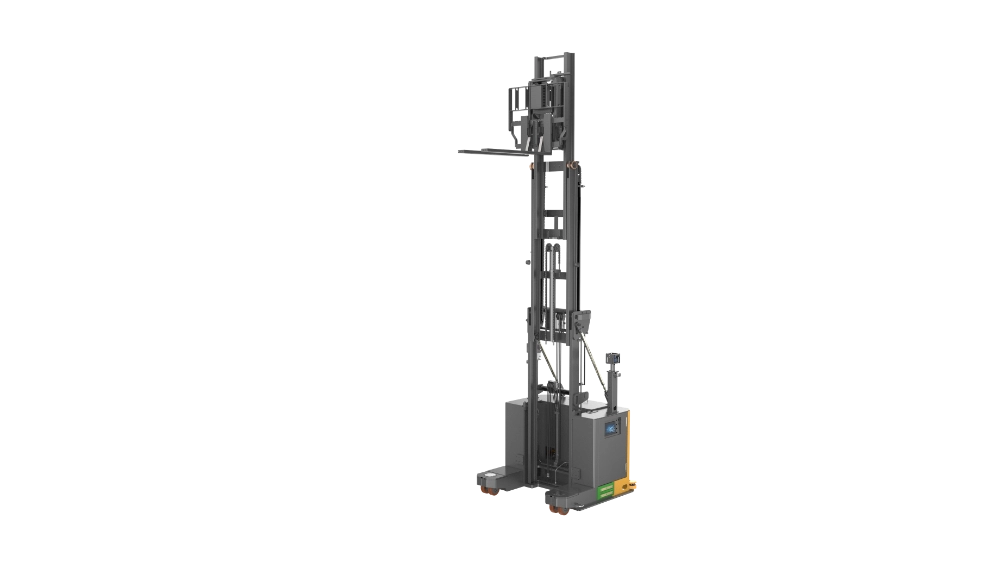
The multi-directional reach truck forklift robot perfectly solves this pain point. As a transformative intelligent solution launched by XGEN Robot, it is designed to maximize storage density while maintaining outstanding operational flexibility. This guide explores how these advanced forklift robots redefine the possibilities of modern material handling.
1. The Power of Multi-Directional Movement
Conventional forklift robots usually require a large turning radius, forcing warehouses to reserve extra-wide aisles. This wastes up to 40% of potential storage space.
360° Omni-Directional Movement
The multi-directional drive system enables the robot to move freely in all directions — sideways, diagonally, and rotate in place.
- Sideways Movement: It can navigate extremely narrow aisle (VNA) without complicated U-turns.
- Zero Turning Radius: Enables precise docking and pallet placement in corner areas that were previously inaccessible to automation equipment.
Why It Is Critical for High-Density Storage
By eliminating the need for wide turning corridors, XGEN Robot allows you to narrow aisle widths and add more shelf rows. Under the same floor area, the number of pallet positions can be greatly increased.
2. Reach Function: High-Level Precision
What distinguishes a reach truck robot from standard stacker robots is its ability to extend the forks forward into shelf positions.
Double-Deep Stacking Storage
With the reach mast mechanism, these robots support double-deep shelf configuration. Storing two pallets deep in one single aisle can increase warehouse density by another 30% compared with single-deck selective racking.
High-Level Stacking
In autonomous systems, stability is the key to high-lifting operation. Combined with advanced mast stabilization systems and real-time load sensing technology, XGEN Robot maintains millisecond-level pallet placement accuracy even at a lifting height of up to 10 meters.
3. Laser SLAM: Boundless Intelligence
High-density warehouses are dynamic and busy. Infrastructure-dependent navigation such as magnetic tapes or wall reflectors is difficult to maintain in narrow spaces.
Infrastructure-Free Navigation
Equipped with Laser SLAM (Simultaneous Localization and Mapping), our forklift robot can build a digital twin map of your warehouse autonomously.
- Adaptive Path Planning: When aisles are blocked by staff or other equipment, the robot instantly recalculates an alternative route, including sideways movement to bypass obstacles.
- Dynamic Mapping Update: As inventory moves and shelf layouts change, the SLAM system updates the map in real time without downtime or reprogramming.
4. Safety Performance in Confined Spaces
Operating heavy-duty intelligent machinery at stable speed in narrow aisles requires multi-layer safety protection.
3D Perception and Semantic Recognition
XGEN Robot equips multi-directional forklift robots with 3D LiDAR and depth cameras to provide a full hemispherical viewing field.
- Human Detection: The robot can distinguish static pallets from on-site workers, adjusting speed and safety buffer distance accordingly.
- Anti-Tip Protection: Advanced gyroscope sensors monitor the center of gravity during high-level reaching operations, automatically slowing down movements to avoid instability and tipping risks.
5. Seamless Integration with WMS / WCS
The efficiency of a high-density warehouse depends on the data system driving it.
Real-Time Fleet Coordination
Our robots do not work independently. They connect to the centralized Robot Control System (RCS), bridging the gap between Warehouse Management System (WMS), Warehouse Control System (WCS) and on-site operation workflows.
- Task Prioritization: The system analyzes the entire robot fleet and assigns tasks to the nearest available unit, minimizing empty driving time.
- Congestion Management: In narrow aisle environments, RCS coordinates robot traffic to prevent multiple units from entering the same aisle simultaneously, ensuring smooth throughput.
6. Sustainable & Low-Maintenance Design
The shift toward automation also represents a shift toward sustainable warehouse operation.
Energy Efficiency
Multi-directional movement optimizes travel routes and reduces energy consumption per pallet movement. Equipped with fast-charging lithium batteries, XGEN Robot supports 24/7 continuous operation through intermittent fragmented charging during workflow breaks.
Reduced Wear and Tear
Traditional differential steering and sharp rotation cause heavy pressure on tires and warehouse floors. Smooth multi-directional traveling reduces mechanical stress, lowering long-term maintenance costs for both robots and facility ground surfaces.
Conclusion: Redefine Your Warehouse Capacity with XGEN Robot
The era of choosing either high density or automation is over.With multi-directional reach truck forklift robot, you can achieve both. By narrowing aisles, accessing deep shelf positions, and adopting intelligent Laser SLAM navigation, your warehouse can be transformed into a high-performance engine driving business growth.
Explore the full range of XGEN Robot Forklift Mobile Robot products and discover how we help you unlock hidden capacity inside your facility.
FAQ
Q1: Are multi-directional robots slower than traditional AGVs?
A1: On the contrary, they perform better in complex layouts. Since multi-directional robots do not need multiple turns and alignments to approach shelves, their single pallet movement cycle time is significantly shorter than traditional vehicles that must stop and rotate repeatedly.
Q2: How much can the aisle width be reduced?
A2: Conditions vary by facility, but many customers can narrow the aisle from over 3.5 meters for manual reach trucks down to only 2.8 meters.
Q3: How does the robot handle different pallet types in high-density scenarios?
A3: The robot adopts AI vision pallet recognition technology. Even if pallets are slightly damaged or placed at an angle, the sensors can identify fork hole positions in real time, automatically adjusting the posture of the robot and forks to ensure safe and successful loading and unloading.