
Warehouse storage density is closely related to how efficiently both floor space and vertical space are utilized. As land and warehouse construction costs continue to increase, more companies are looking for ways to store more pallets without expanding their existing warehouse footprint.
In high-density warehouse layouts, narrow aisle forklifts can provide a practical solution. By reducing the space required for forklift operation, narrow aisle forklifts can help warehouses accommodate more racking systems and pallet storage positions within the same building area.
However, increasing warehouse storage density is not simply a matter of reducing aisle width. Forklift dimensions, pallet specifications, load capacity, lifting height, racking configuration, and internal material flow all need to be considered as part of an integrated warehouse design.
So, how exactly can narrow aisle forklifts help increase warehouse storage density?
1. Reduce Aisle Width to Free Up More Storage Space
A significant amount of warehouse floor space can be occupied by forklift travel and turning areas. Traditional counterbalance forklifts generally require wider operating aisles, which can limit the number of rack rows and overall storage positions.
Narrow aisle forklifts feature a more compact design and require less space for maneuvering. This allows warehouses to reduce aisle width while maintaining normal pallet handling and storage operations.
The space saved can then be used to add more rack rows or storage positions, increasing the number of pallets that can be stored within the same floor area.
It is important to note that the actual aisle width should be determined based on factors such as forklift specifications, pallet dimensions, load characteristics, racking configuration, and required safety clearances. There is no single aisle width that is suitable for every warehouse.
2. Make Better Use of Vertical Warehouse Space
Reducing aisle width is only one part of increasing storage density. Another important approach is to make better use of the warehouse’s vertical space.
When floor space is limited, increasing rack height can provide additional pallet storage positions. However, the forklift must have sufficient lifting capacity, stability, positioning accuracy, and mast height to safely support high-level pallet storage operations.
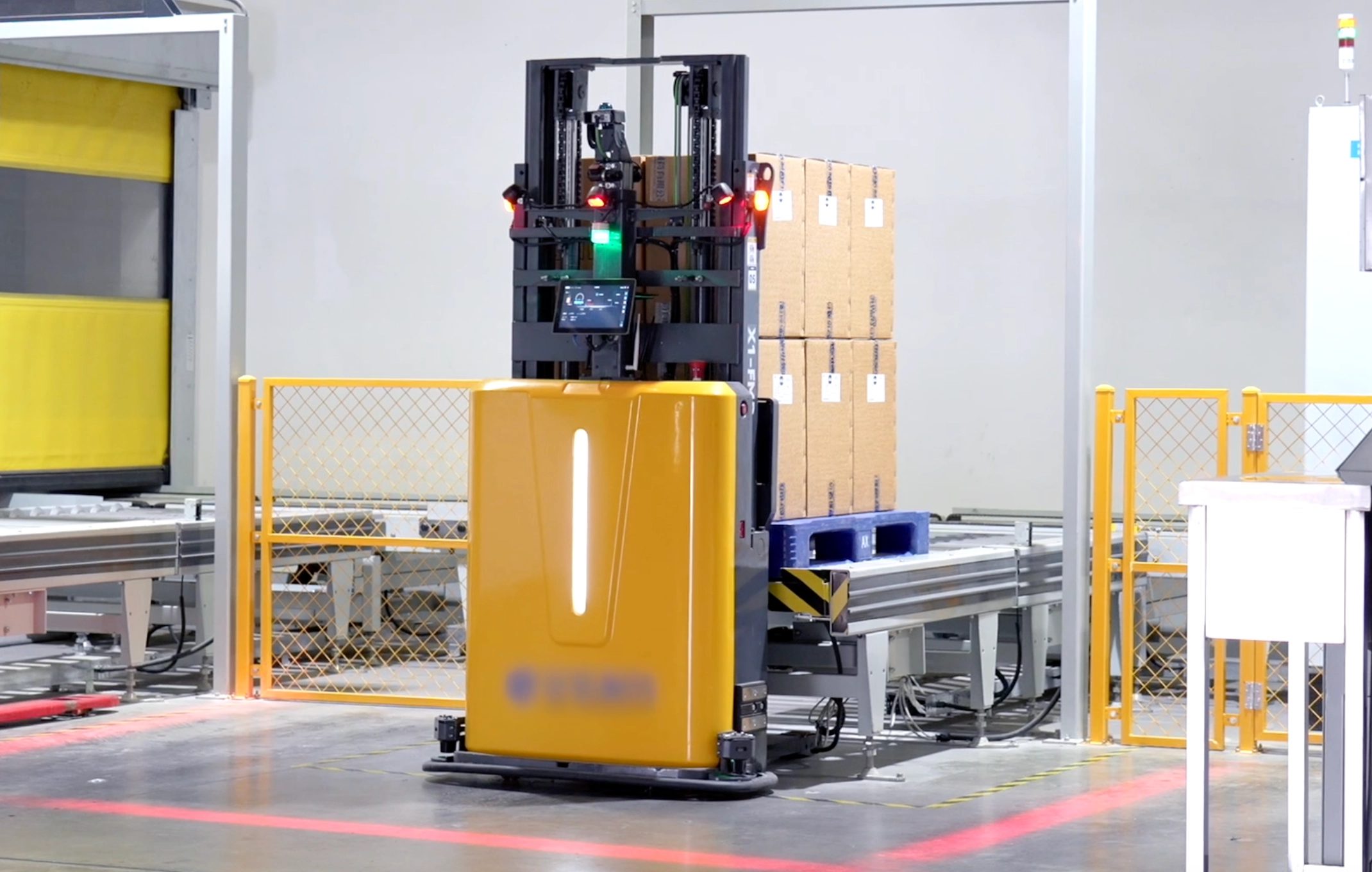
For example, XGEN Robot’s Narrow Aisle Stacker FMR has a maximum load capacity of up to 2,000 kg and a maximum lifting height of up to 3.5 m. Its compact design is suitable for narrow aisle warehouse environments and can help reduce space constraints during material handling operations.
3. Use Multi-Directional Movement for Ultra-Narrow Aisles
Traditional forklifts generally need to turn the entire vehicle when entering or exiting a racking aisle. This requires additional maneuvering space and can limit the minimum practical aisle width.
Multi-directional forklifts use different movement modes to travel forward, backward, sideways, or diagonally. This allows the vehicle to maneuver within limited spaces while reducing the need for large turning areas.
XGEN Robot’s multi-directional narrow aisle FMR is designed for high-density warehouse applications. It uses an omnidirectional drive system that enables 360-degree movement and turning. Combined with pallet recognition technology, the system can perform accurate rack positioning and pallet handling operations. Under suitable operating conditions, the vehicle can operate in aisles as narrow as approximately 1.7 m.
This type of equipment can be particularly useful for warehouses that need to maximize racking density or handle long and difficult-to-position loads.
4. Combine Narrow Aisle Forklifts with the Right Racking System
A narrow aisle forklift alone does not determine warehouse storage density. The racking system should also be designed around the selected forklift and the warehouse’s operational requirements.
Depending on specific storage needs, warehouse operators may consider:
- Selective pallet racking for greater storage flexibility and direct pallet access
- Double-deep racking to further increase storage density
- High-bay racking to make better use of vertical space
- Narrow aisle or very narrow aisle layouts for warehouses with limited floor space
Therefore, forklifts, pallets, racking systems, and aisles should be considered as an integrated warehouse storage system.
A common approach is to design the racking layout first and then select a forklift. However, if the forklift requires more operating space than the planned aisle width allows, part of the storage capacity may have to be sacrificed, or the warehouse layout may need to be redesigned.
A more practical approach is to first determine pallet dimensions, load characteristics, rack height, and material flow requirements, and then select a narrow aisle forklift that matches the overall warehouse design.
5. Improve Pallet Positioning Accuracy
Warehouse storage density does not only depend on the number of racks. The amount of usable space around each pallet position is also important.
Accurate pallet positioning allows warehouses to make more efficient use of available rack space while maintaining the necessary operating and safety clearances. This becomes especially important in high-density and high-level storage environments.
Automated forklifts and mobile robots can further improve positioning consistency through navigation and localization technologies. XGEN Robot’s FMR solutions use technologies such as laser SLAM navigation together with pallet recognition capabilities to support automated material handling and precise movement within the warehouse.
6. Maintain Efficient Material Flow in High-Density Layouts
Improving storage density should not come at the expense of the overall throughput efficiency of the warehouse.
If the aisles are very narrow but forklifts need to perform complex turning operations frequently, wait for other vehicles, or travel long distances between storage areas and picking areas, the theoretical storage capacity may not necessarily translate into actual warehouse efficiency.
Therefore, high-density warehouse planning needs to consider both storage capacity and logistics efficiency.
For automated warehouses, narrow aisle FMRs can be integrated with WMS and robot scheduling systems. For example, XGEN Robot’s Narrow Aisle Stacker FMR can connect with WMS and robot scheduling systems to achieve automated material handling between conveying equipment, storage areas, and temporary staging areas near loading docks.
In this way, the forklift is no longer an independently operating material handling device, but becomes part of the entire warehouse automation system.
7. Select the Right Forklift According to Actual Warehouse Requirements
Different warehouses have different layouts and operational requirements, so there is no single narrow aisle forklift that is suitable for all scenarios.
Before selecting a solution, warehouse operators should comprehensively evaluate:
- Warehouse dimensions and available floor space
- Pallet dimensions and load weight
- Required lifting height
- Existing or planned racking configuration
- Required aisle width
- Turning radius and vehicle operating space
- Daily pallet throughput
- Navigation and safety requirements
- WMS/WCS or warehouse automation system integration requirements
- Future expansion and storage requirements
For example, for warehouses with moderate lifting height requirements and mainly standard pallet handling, a compact Narrow Aisle Stacker FMR can be considered. For high-level storage, a Reach Truck can be considered. For ultra-narrow aisles or warehouses with complex layouts, multi-directional forklifts can provide more flexible movement capabilities.
How Can Narrow Aisle Forklifts Become Part of High-Density Warehouse Automation?
The goal of a high-density warehouse is not simply to reduce aisle width, but to achieve a better balance between storage capacity, goods accessibility, safety, and material handling efficiency.
Narrow aisle forklifts can help warehouses improve space utilization by reducing the space required for vehicle operation. When combined with high-bay racking, appropriate pallet configurations, precise positioning, and automated navigation, they can further increase pallet storage capacity without expanding the warehouse building area.
XGEN Robot’s narrow aisle automated guided forklifts are developed for narrow aisle warehousing scenarios and can be used for pallet handling and stacking operations in high-bay racking environments. If your warehouse is facing issues such as limited floor space and insufficient pallet storage capacity, then evaluating your existing aisle layout and forklift requirements can be a practical starting point for increasing warehouse storage density.