
Table of Contents
A latent mobile robot is a low-profile autonomous mobile robot designed to travel beneath a pallet, mobile rack, or custom material cart, lift it slightly, and transport it to a defined destination. Unlike a conventional forklift that lifts material from the side, this underdrive approach keeps the load low to the ground, reduces the need for wide turning areas, and enables continuous material flow in warehouses and production facilities.
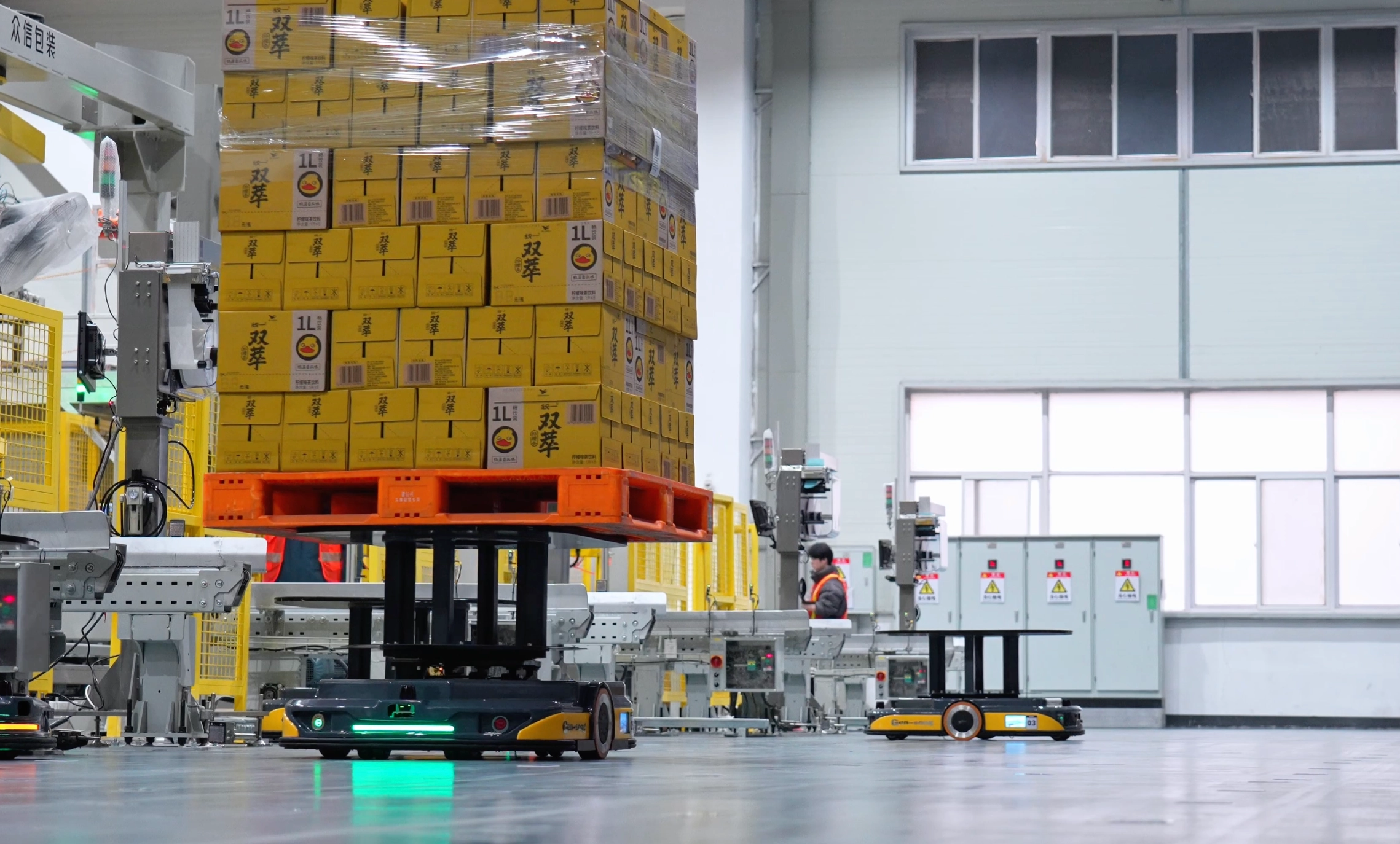
For operations handling palletized goods, mobile shelving, or standardized carts, a latent mobile robot AMR can automate repetitive transport without requiring a major change to existing floor layouts. The key is understanding how the robot completes a full transport cycle: receiving a task, navigating to the load, positioning beneath it, lifting, traveling, releasing, and returning for the next assignment.
What Is Underdrive Transport?
Underdrive transport means the robot does not carry the load on top of its chassis. Instead, it enters the open space beneath a compatible carrier, raises it using an integrated lifting mechanism, and moves the entire carrier as one unit.
This method is particularly suitable for:
- Pallets with sufficient bottom clearance
- Mobile racks and shelving units
- Material carts used between production stations
- Standardized carriers in e-commerce fulfillment and manufacturing
- Loads that need to be moved frequently over short or medium distances
Because the robot remains beneath the load, the combined height is often lower than that of a conventional lifting vehicle. This can help facilities use existing aisles more efficiently and move material between workstations without extensive infrastructure modification.
The Complete Operating Cycle
A latent mobile robot AMR does not simply drive from one point to another. Each transport task follows a coordinated sequence involving the dispatch system, navigation system, lifting mechanism, and safety functions.
1. Task Assignment
The process begins when a warehouse management system, manufacturing execution system, or operator interface creates a transport request. The request typically includes the pickup location, destination, carrier type, priority level, and required delivery time.
The dispatch management system evaluates available robots, current positions, battery status, traffic conditions, and task priorities. It then assigns the most suitable robot to the job.
For example, if a picking station needs an empty mobile rack, the system identifies the nearest available robot with sufficient battery capacity and assigns it to retrieve a loaded rack from a staging area.
2. Navigation to the Pickup Point
Once the task is assigned, the robot plans a route to the pickup location. Depending on the deployment environment, it may use QR code navigation, laser SLAM navigation, or a hybrid approach combining both methods.
QR code navigation uses floor markers to provide repeatable positioning and stable route guidance. It is often effective in structured warehouses where routes, docking points, and workstations are clearly defined.
Laser SLAM navigation allows the robot to build and update a map of its surroundings using laser-based perception. This can be useful in environments with changing layouts, temporary obstacles, or areas where floor markers are difficult to maintain.
In many real-world projects, facilities combine approaches: QR codes provide precise docking and positioning, while laser-based navigation supports flexible travel across broader areas.
3. Approaching the Carrier
As the robot approaches the target pallet or rack, it slows down and begins precise alignment. The objective is not merely to reach the general pickup area, but to position the robot accurately beneath the carrier.
This stage depends on several factors:
- The width and length of the robot chassis
- The available clearance under the carrier
- The position of support legs, wheels, or structural members
- The required approach direction
- The accuracy needed for the lifting interface
A typical latent mobile robot uses a differential drive system, allowing forward and backward movement as well as spot rotation. This is valuable in confined areas because the robot can adjust its angle without needing a large turning radius.
For instance, a compact model with a minimum turning radius below 0.5 m can maneuver in tighter production aisles, while larger models designed for heavier loads require more space but provide higher payload capability.
4. Positioning Beneath the Load
After reaching the pickup point, the robot aligns itself with the carrier’s underside. Accurate alignment is essential because the lifting mechanism must engage the carrier safely and evenly.
High-precision positioning reduces the risk of uneven lifting, misalignment, or contact with the carrier structure. In a well-designed deployment, the robot can achieve horizontal positioning accuracy of approximately ±10 mm and angular accuracy of about ±1°.
This level of precision is important for pallet handling and mobile rack transport because even a small alignment error can affect stability, especially when moving heavy or high-center-of-gravity loads.
5. Lifting the Carrier
Once aligned, the robot activates its lifting mechanism. In a latent mobile robot, this is commonly a screw-based lifting system. The screw mechanism converts rotational motion into controlled vertical movement, raising the carrier plate and lifting the load slightly off the ground.
The lifting height is intentionally limited. Rather than raising a pallet several feet into the air, the robot lifts it just enough to clear the floor and allow safe movement.
Typical lifting heights range from 60 mm to 120 mm, depending on the model and application. This low-lift approach offers several advantages:
- Lower center of gravity during transport
- Reduced risk associated with elevated loads
- Less energy consumption compared with high-lift handling
- Compatibility with low-clearance carriers
- Simpler integration into existing warehouse layouts
For lighter applications, a 60 mm lifting height may be sufficient. Heavier models may use a 120 mm lifting height to accommodate larger pallets, racks, or specialized carriers.
6. Transporting the Load
With the carrier securely lifted, the robot begins transport. The dispatch and traffic management systems continue to monitor its route, speed, and surrounding conditions.
During travel, the robot must handle several operational variables:
- Other mobile robots operating in the same area
- Pedestrians or manual equipment entering the pathway
- Temporary obstructions
- Intersections and congestion points
- Charging station availability
- Changes in task priority
A well-managed fleet does not rely on individual robots making isolated decisions. The traffic management system coordinates movement across the site, helping prevent deadlocks, reduce waiting time, and maintain predictable material flow.
For example, if two robots approach the same narrow aisle from opposite directions, the system can assign priority to one robot and instruct the other to wait or take an alternative route.
7. Delivering and Releasing the Carrier
At the destination, the robot again performs precise positioning. It aligns with the designated drop-off point, lowers the carrier smoothly, and disengages from the load.
The release process must be controlled to avoid sudden movement or uneven contact with the floor. After the carrier is safely resting in place, the robot withdraws and confirms completion of the task.
The system then updates the task status, releases the robot for the next assignment, and records operational data such as transport time, distance traveled, battery consumption, and task completion status.
8. Returning to Charge or Next Task
If battery levels are sufficient, the robot may proceed directly to another transport task. If the battery is approaching a defined threshold, the dispatch system directs it to a charging station.
Modern AMR fleets often use opportunity charging. Rather than waiting until the battery is nearly empty, robots recharge during natural gaps in demand. This helps maintain availability during peak periods and reduces the need for oversized battery capacity.
A practical deployment should consider:
- Number of daily transport cycles
- Average travel distance per task
- Load weight and travel speed
- Charging station locations
- Peak-hour task volume
- Battery aging over time
These factors determine whether a facility needs additional robots, more charging points, or a revised task-allocation strategy.
Why the Lifting Mechanism Matters
The lifting mechanism is one of the most important components in a latent mobile robot. It determines how safely and reliably the robot can engage, lift, transport, and release a carrier.
A screw lifting mechanism provides controlled vertical movement and stable load support. Unlike a simple hook or passive interface, it can raise the carrier with greater consistency, which is important when transporting pallets or racks repeatedly throughout a shift.
The mechanism must also be matched to the application. A 600 kg robot may be suitable for light carts or small mobile racks, while a 3,000 kg model is better suited to heavy pallets, dense storage racks, or demanding manufacturing environments.
Choosing the right lifting capacity is not only about the heaviest possible load. It should also account for:
- The actual weight of the carrier
- The weight of goods on the carrier
- Dynamic forces during acceleration and braking
- Floor conditions and slope
- Frequency of lifting cycles
- Future growth in product weight or order volume
How Navigation Supports Reliable Transport
Navigation determines whether the robot can operate consistently in a live facility. A latent mobile robot must do more than follow a line; it must locate itself, avoid obstacles, coordinate with other vehicles, and stop safely when necessary.
QR Code Navigation
QR code navigation uses visual markers placed on the floor. The robot reads these markers to confirm its position and follow a defined route.
This method is often favored for:
- High-repeat transport routes
- Fixed pickup and drop-off locations
- High-precision docking
- Facilities with stable layouts
- Projects that require predictable, repeatable operation
The main advantage is consistency. Once the route and markers are installed, the robot can repeatedly reach the same position with high accuracy.
Laser SLAM Navigation
Laser SLAM navigation uses laser perception to map the environment and determine the robot’s position. It can be useful where floor markings are impractical or where the layout changes frequently.
This approach may suit:
- Manufacturing plants with evolving production layouts
- Facilities with limited floor-marking options
- Areas with complex or variable traffic patterns
- Operations that require route flexibility
Laser reflector-based hybrid navigation can further improve reliability in large or structurally complex sites by combining environmental mapping with fixed reference points.
Safety Functions in Daily Operation
Safety is central to any autonomous material-handling deployment. A latent mobile robot operates around people, manual equipment, racking, and other vehicles, so it must detect risks and respond appropriately.
Common safety functions include:
- Front obstacle detection and avoidance
- Optional rear obstacle detection
- Safety bumper detection
- Emergency stop buttons
- Audible alarms and status lights
- Speed control in pedestrian areas
- Controlled braking and lifting sequences
The robot should slow down or stop when it detects a person, obstruction, or unexpected condition. In addition, the lifting process should only begin when the robot is correctly positioned and the carrier is compatible with the lifting interface.
Safety is not only a hardware feature. It also depends on site design, traffic rules, pedestrian zones, loading standards, and clear procedures for handling exceptions.
Typical Applications
Latent mobile robot AMRs are used across industries where materials must move repeatedly between defined locations.
E-Commerce Fulfillment
In fulfillment centers, mobile racks can be transported between storage zones, picking stations, packing areas, and outbound staging zones. The robot helps reduce walking distance and supports higher order throughput during peak periods.
Manufacturing Intralogistics
In production facilities, the robot can move raw materials, semi-finished goods, tooling carts, or finished products between storage, production lines, inspection areas, and packaging stations.
High-Density Warehousing
For warehouses using mobile racking or standardized carriers, latent mobile robots can improve storage density by reducing the space required for vehicle maneuvering.
Multi-Shift Operations
Because the robot can operate continuously with scheduled charging, it is suitable for facilities that need consistent material flow across multiple shifts.
How to Assess Site Readiness
Before deploying a latent mobile robot AMR, facilities should assess whether the existing environment supports underdrive transport.
Key evaluation points include:
- Bottom clearance of pallets, racks, and carts
- Floor flatness, cleanliness, and load-bearing capacity
- Aisle width and turning space
- Pickup and drop-off point dimensions
- Carrier standardization
- Task frequency and peak demand
- Wi-Fi coverage and network reliability
- Integration requirements with WMS, MES, or ERP systems
- Pedestrian traffic and safety zoning
A site does not need to be fully redesigned to use this technology. In many cases, the most effective approach is to begin with a defined transport route, standardize the carrier interface, and expand gradually as operational confidence increases.
Choosing the Right Configuration
The right latent mobile robot depends on the load, carrier type, travel distance, and operating environment.
| Requirement | Suitable Configuration |
| Light carts or small mobile racks | Lower-capacity model with compact chassis |
| Standard pallet transport | Mid-capacity model with reliable navigation and precise docking |
| Heavy pallets or dense racks | Higher-capacity model with stronger lifting capability |
| Fixed, repeatable routes | QR code navigation |
| Changing layouts or flexible routing | Laser SLAM or hybrid navigation |
| High-frequency operation | Fleet dispatch and opportunity charging strategy |
XGEN Robot offers latent mobile robot AMR models ranging from 600 kg to 3,000 kg load capacity, with QR code navigation as standard and laser SLAM or laser reflector navigation available for more complex environments. Its A1 series is designed for underdrive pallet and rack transport, combining differential drive, screw lifting, dispatch management, and traffic management to support material handling in warehouses and manufacturing facilities.
Final Perspective
A latent mobile robot AMR works by combining autonomous navigation, precise under-carrier positioning, controlled lifting, and coordinated fleet management. Its value comes not from replacing every material-handling task, but from automating the repetitive movement of compatible pallets, racks, and carts across a facility.
For operations seeking to improve material flow without rebuilding the entire warehouse, underdrive transport offers a practical path toward higher density, reduced manual handling, and more predictable intralogistics performance.