
In high-bay racking, narrow-aisle warehouses, and high-density storage environments, reach trucks are commonly used for pallet handling and high-level storage and retrieval. With the development of warehouse automation, Forklift Mobile Robots have also begun to be used for high-level stacking, automated storage, and pallet handling.
During the actual selection process, users may encounter two different types of reach trucks: Moving Mast Reach Trucks and Fixed Mast Reach Trucks.
Both can be used for high-level racking operations, but there are significant differences in mast structure, fork extension method, stability, racking adaptability, and application scenarios.
What Is a Moving Mast Reach Truck?
The key feature of a Moving Mast Reach Truck is that the mast can move forward.
During pallet picking or placement, the mast and forks move forward toward the rack, allowing the forks to extend into the rack. After the pallet operation is completed, the mast retracts, reducing the amount of space required for the vehicle to enter deeper into the rack.
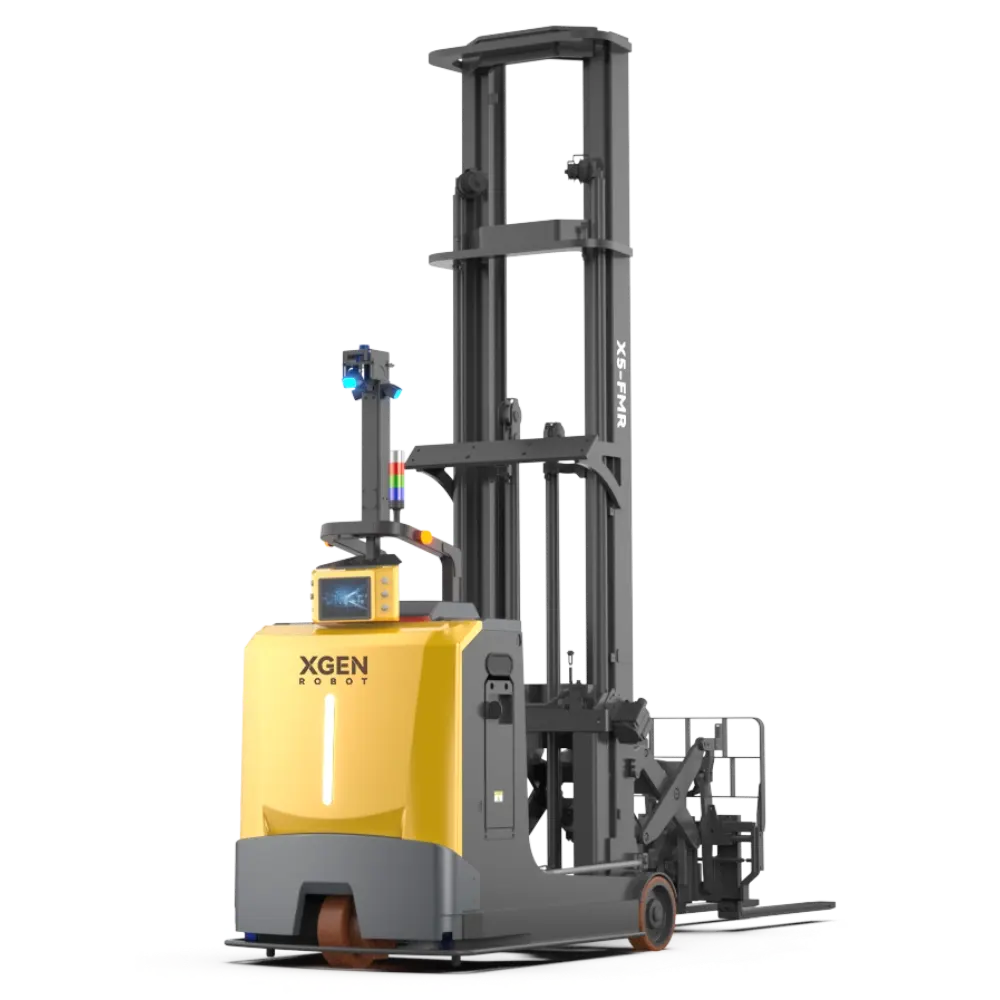
XGEN Robot’s Moving Mast Reach Truck uses a reach-forward mast design and can be used for high-level racking storage. Its related products can reach lifting heights of approximately 10 meters and are designed for high-level stacking applications.
The advantages of this structure include:
- Larger fork reach distance
- Suitable for high-level pallet storage and retrieval
- Can adapt to racking systems at different heights
- Suitable for standard pallet handling and stacking
- Can be integrated with automated navigation and warehouse management systems
For warehouses that need to combine high-level storage with automated material handling, a Moving Mast Reach Truck is a common solution.
What Is a Fixed Mast Reach Truck?
The mast of a Fixed Mast Reach Truck remains fixed to the vehicle chassis and does not move forward.
Unlike a moving mast reach structure, a Fixed Mast Reach Truck typically uses telescopic forks, scissor forks, or other fork extension mechanisms to move pallets forward and backward.
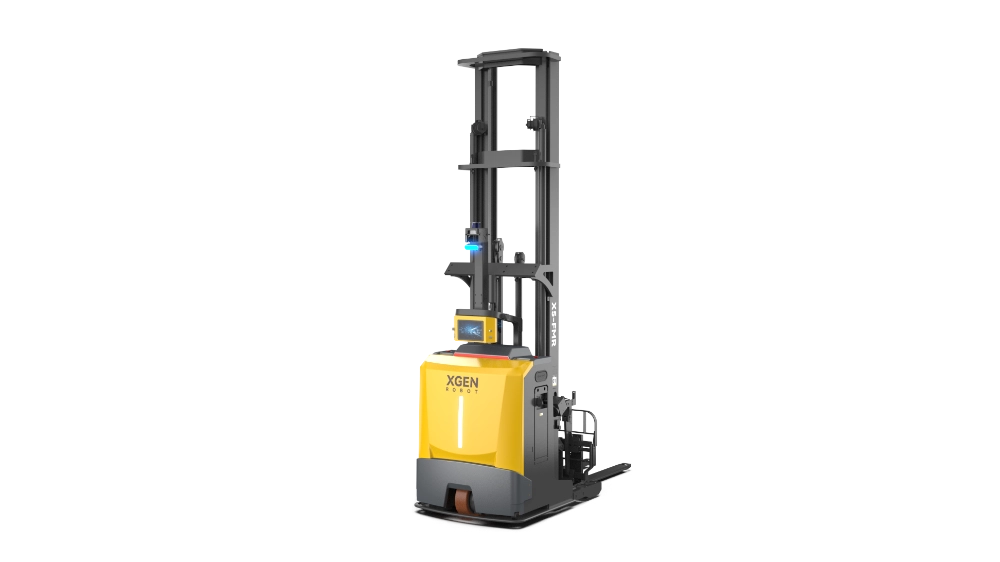
For example, XGEN Robot’s Fixed Mast Reach Truck uses a fixed mast and scissor-fork forward extension design, with a maximum rated load capacity of 2,000 kg and a maximum lifting height of 6,096 mm. This structure can also be used with double-deep racking to further increase warehouse storage density.
An important feature of the fixed mast structure is its relatively high structural rigidity. Since the mast is fixed to the chassis, the forward extension movement is mainly performed by the fork mechanism, providing stable structural support during high-level operations.
What Are the Differences Between Moving Mast and Fixed Mast Reach Trucks?
Although both structures can be used for pallet handling, they differ in mechanical structure and operating characteristics.
| Comparison Item | Moving Mast Reach Truck | Fixed Mast Reach Truck |
| Mast Movement | The mast can move forward and backward | The mast remains fixed |
| Load Positioning | Approaches the rack through mast movement | Uses forks/scissor mechanism for forward extension |
| Aisle Operations | Suitable for some narrow-aisle applications | Depends on the forklift and racking configuration |
| Load Handling | Suitable for high-level stacking | Suitable for high-level and high-density stacking |
| Warehouse Applications | High-level racking and pallet storage/retrieval | High-density storage and double-deep racking |
| Structural Characteristics | Flexible reach range | Higher structural rigidity |
It should be noted that the actual performance of a forklift depends not only on the mast structure, but also on factors such as rated load capacity, lifting height, load center, overall vehicle dimensions, turning radius, and control system.
How to Choose Between a Moving Mast and Fixed Mast Reach Truck?
If the warehouse mainly uses standard pallet racking and requires high-level storage and retrieval, a Moving Mast Reach Truck can be considered as a key option. Its reach-forward mast structure can meet common high-level pallet handling requirements.
If the warehouse places greater emphasis on double-deep racking and high-density storage, a Fixed Mast Reach Truck can be considered, especially an FMR equipped with a scissor-fork forward extension mechanism.
It should be noted that this is only an initial selection guideline. The final equipment configuration still needs to be confirmed based on pallet dimensions, load weight, rack height, aisle width, and the actual operating process.
Conclusion
The key difference between Moving Mast Reach Trucks and Fixed Mast Reach Trucks lies in their different mast and fork extension mechanisms.
A Moving Mast Reach Truck achieves forward reach by moving the mast and is suitable for high-level racking and conventional pallet storage and retrieval. A Fixed Mast Reach Truck keeps the mast fixed and uses telescopic or scissor forks for forward extension, making it more suitable for certain high-density and double-deep racking applications.
For automated warehouses, what really matters is matching the forklift structure with the racking system, pallets, aisles, lifting height, and logistics process.
If you are planning an automated high-level warehousing system, you can provide the warehouse dimensions, aisle width, rack height, pallet specifications, and load weight. XGEN Robot can evaluate the appropriate Moving Mast Reach Truck FMR or Fixed Mast Reach Truck FMR configuration based on your specific application and provide the corresponding automated material handling solution.