
Autonomous forklift mobile robots (FMRs) are increasingly used to transport pallets, raw materials, and finished goods between production lines, warehouses, loading areas, and outdoor staging zones. However, deploying a robot across both indoor and outdoor environments presents different challenges from operating exclusively inside a controlled warehouse.
Changes in floor conditions, lighting, navigation references, weather exposure, and traffic patterns can all affect operational reliability. A robot that performs well on a smooth warehouse floor may not deliver the same results when crossing outdoor pavement, navigating loading bays, or moving between buildings.
For businesses evaluating an autonomous FMR, the key is to match the robot’s technical specifications to the actual operating environment. Load capacity, navigation technology, environmental protection, maneuverability, battery management, and system integration should be evaluated together rather than as isolated features.
1. Load Capacity and Load Center: Match the Robot to Real Cargo Conditions
Payload capacity is one of the first specifications to evaluate when sourcing an autonomous FMR. Nevertheless, selecting a robot based solely on its maximum rated capacity can lead to problems during actual operation.
The required capacity depends on the weight, dimensions, center of gravity, and handling characteristics of the loads being transported. Palletized goods, industrial components, and oversized materials can place different demands on the lifting mechanism and vehicle stability.
When comparing models, consider these factors:
Rated load capacity: Confirm that the robot can handle the heaviest loads expected in routine operations, including packaging and pallet weight.
Load center: Check whether the rated capacity applies to the actual distance between the load’s center of gravity and the fork face.
Lift height: Verify that the lifting height meets the requirements of racks, transfer stations, and loading platforms.
Load dimensions: Ensure that the forks can safely support the pallet or cargo without excessive overhang.
Operating frequency: Account for repeated lifting, acceleration, braking, and turning throughout each shift.
A robot’s rated capacity may decrease under certain load-center or lifting-height conditions. Buyers should therefore review the manufacturer’s load specifications and applicable load charts rather than assuming that the maximum rating applies to every configuration.
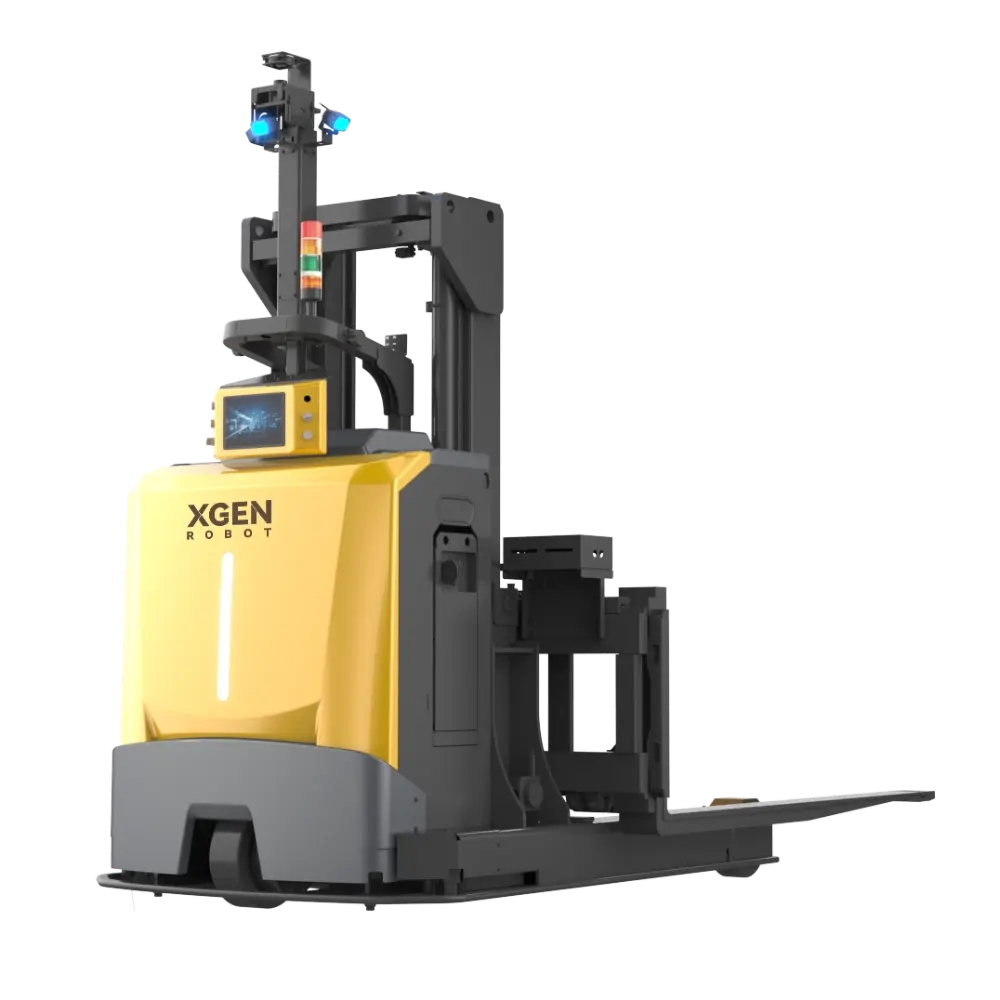
For heavy industrial materials or frequent pallet transfers, a Heavy-duty FMR Robot may be appropriate, provided its rated capacity, chassis design, and handling characteristics match the intended workload.
2. Navigation Technology: Ensure Reliable Movement Across Different Environments
Navigation is particularly important when an autonomous FMR must move between indoor production areas and outdoor logistics zones.
Indoor environments often provide relatively stable reference points, such as walls, racks, and fixed equipment. Outdoor areas introduce additional variables, including changing sunlight, open spaces, moving vehicles, pedestrians, and fewer consistent structural references.
Evaluate SLAM-Based Navigation Capabilities
Simultaneous localization and mapping (SLAM) allows a robot to build or use a representation of its surroundings while estimating its own position. Depending on the implementation, the system may combine LiDAR, cameras, inertial sensors, and other positioning technologies.
A 3D SLAM Forklift Robot can be worth evaluating when the application involves complex spatial layouts, varying surroundings, or navigation requirements that benefit from three-dimensional environmental information. However, the presence of 3D SLAM alone does not guarantee reliable outdoor performance.
During technical evaluation, ask suppliers whether the robot can maintain localization when moving between indoor and outdoor spaces, how it responds to changing sunlight or reflective surfaces, whether it can detect temporary obstacles, and what happens if localization confidence drops or a sensor becomes obstructed.
The best approach is to test the robot on representative routes rather than relying exclusively on navigation demonstrations conducted in ideal conditions.
3. Environmental Protection: Verify the Conditions the Robot Can Handle
Environmental suitability is a major consideration for mixed indoor-outdoor operations. A robot may travel outdoors without being designed to operate continuously in exposed conditions.
Buyers should evaluate temperature limits, humidity, dust exposure, water ingress protection, floor drainage, and the degree of weather exposure along the planned route.
Understand IP Ratings Before Selecting a Model
Ingress Protection (IP) ratings indicate the level of protection an enclosure provides against specified solid particles and water ingress under defined test conditions. They do not automatically establish that a complete vehicle is suitable for every outdoor environment.
For example, an IPX4 Automated Forklift designation indicates protection against water splashing from any direction under the relevant test conditions. The X means that no solid-particle protection rating is specified by that designation.
This rating should not be interpreted as proof of protection against heavy rain, water jets, flooding, or prolonged exposure to wet conditions. Buyers should also verify which components the rating covers, including electrical enclosures, sensors, connectors, and other vulnerable assemblies.
Before selecting a robot, establish whether it will operate under a roof or in fully exposed areas, whether routes contain standing water or loose debris, what temperature range is expected, and whether batteries, charging equipment, and sensors are rated for those conditions.
The environmental specification should reflect the most demanding conditions encountered during normal operation, not just the conditions present in the warehouse.
4. Chassis, Ground Clearance, and Tires: Assess Outdoor Mobility
Floor conditions can change significantly between indoor and outdoor routes. Smooth concrete may be followed by asphalt, expansion joints, uneven pavement, ramps, or transitions between different floor levels.
These variations affect traction, vibration, braking, and load stability. A robot designed primarily for smooth indoor flooring may struggle if its wheels, chassis, or ground clearance are unsuitable for the outdoor section.
When comparing autonomous FMR models, assess ground clearance, wheel and tire design, permitted ramp slope, turning radius, and ride stability. Confirm ramp performance under the intended load, including starting, stopping, turning, and braking.
An outdoor-capable counterbalance configuration may be suitable for handling loads that cannot be accommodated conveniently by other forklift designs. An Outdoor Counterbalance FMR should nevertheless be assessed against its specific ground-clearance, traction, load-capacity, and environmental limits.
Request a route trial with representative cargo, particularly where indoor floors connect to outdoor loading or staging areas.
5. Safety Systems: Protect People, Loads, and Equipment
Mixed indoor-outdoor routes often bring autonomous robots into contact with pedestrians, manual forklifts, trucks, and other moving equipment. Safety performance must therefore be evaluated alongside productivity.
A suitable system should provide obstacle detection, speed management, emergency stopping, and appropriate responses to changing traffic conditions. Depending on the application, additional measures may be required at intersections, blind corners, pedestrian crossings, and vehicle loading zones.
Ask what obstacle-detection sensors are installed and what their limitations are, whether the robot can adjust speed according to traffic and load conditions, how it responds to pedestrians entering its path, and whether safety zones can be configured for different areas.
Outdoor conditions deserve particular attention because sunlight, rain, dust, and reflective surfaces can affect some sensing technologies. Buyers should verify the performance of the complete safety system under the intended operating conditions.
Risk assessments, safety functions, and relevant machinery and industrial truck standards should also be reviewed as part of deployment planning. Compliance claims should be supported by documentation for the specific robot model and configuration.
6. Battery Capacity and Charging: Calculate Runtime Around the Real Workload
Battery performance affects fleet availability, especially when the robot operates across multiple shifts or must travel longer distances between indoor and outdoor workstations.
Maximum runtime figures are useful for initial comparison, but they may not represent actual performance under heavy loads, frequent lifting, repeated acceleration, or continuous navigation.
Evaluate battery capacity alongside energy consumption, charging time, expected operating hours, and the number of transport cycles per shift.
An auto-recharging FMR forklift can help reduce manual charging intervention by returning to a charging station when its battery reaches a configured threshold or when the operating schedule requires charging. Confirm that the robot can locate the charger, dock reliably, and resume assigned tasks after charging.
Also consider whether the charging station blocks traffic, whether several robots may need charging simultaneously, and whether enough battery reserve remains for the robot to reach a charging point safely. For multi-shift operations, evaluate charging schedules against peak transport demand rather than average daily usage alone.
7. Fleet Management and System Integration: Confirm the Robot Fits Existing Operations
A technically capable FMR can still underperform if it cannot communicate effectively with existing warehouse and production systems.
For facilities using warehouse management systems (WMS), manufacturing execution systems (MES), enterprise resource planning (ERP) platforms, or automated production equipment, integration requirements should be defined before equipment selection.
Check whether the robot management system supports task dispatching, traffic coordination, status monitoring, error reporting, and operational data collection. If several robots will share routes, verify how the fleet system manages intersections, charging priorities, congestion, and task allocation.
Automatic doors, elevators, conveyors, production lines, and loading stations may require defined communication interfaces and coordinated control sequences. Before finalizing a purchase, clarify supported communication protocols, network-interruption behavior, diagnostic access, and the availability of software updates, spare parts, and technical support.
A site survey and integration test can reveal infrastructure limitations before they become costly commissioning problems.
8. How to Compare Autonomous FMR Specifications Before Purchasing
Use the following checklist to compare candidate models against the same operational requirements.
| Specification | What to Verify | Why It Matters |
| Payload capacity | Rated load, load center, and lift height | Prevents overloading and unsuitable load handling |
| Navigation | SLAM method, sensor configuration, and localization recovery | Supports reliable movement across changing environments |
| Environmental protection | IP ratings, temperature limits, and component-level protection | Establishes actual limits for outdoor exposure |
| Mobility | Ground clearance, tires, turning radius, and ramp capability | Determines suitability for real floor conditions |
| Safety | Obstacle detection, speed control, and emergency stopping | Helps manage interactions with people and equipment |
| Battery | Runtime under load, charging time, and charging method | Supports throughput and fleet availability |
| Integration | Software interfaces, fleet management, and equipment communication | Enables coordinated workflows |
| Serviceability | Diagnostics, maintenance requirements, and spare-parts support | Reduces operational disruption over time |
Rather than ranking suppliers by a single specification, evaluate each model against a defined set of operating scenarios. For example, a robot may need to collect pallets from an indoor production line, pass through a doorway, cross an outdoor loading area, and deliver materials to a staging point.
Testing the complete route helps reveal whether the combined navigation, chassis, safety, and battery capabilities meet the application’s requirements.
Frequently Asked Questions
Can an indoor autonomous forklift be used for outdoor operations?
Not necessarily. Outdoor suitability depends on the robot’s navigation system, environmental protection, tires, ground clearance, braking performance, and permitted operating conditions. A model designed for smooth indoor floors should not be assumed to handle exposed outdoor routes safely.
Is 3D SLAM enough for reliable indoor-outdoor navigation?
No. 3D SLAM can support localization and environmental mapping, but overall performance also depends on sensor configuration, lighting conditions, route characteristics, obstacle handling, and localization recovery. Testing the complete route under representative conditions is essential.
How should I determine the required FMR payload capacity?
Start with the heaviest expected load, including the pallet and packaging. Then verify the load center, lifting height, load dimensions, and operating conditions against the manufacturer’s rated-capacity specifications. Allowance for future workload changes may also be appropriate.
What should I check before purchasing an auto-recharging FMR?
Confirm the actual runtime under load, charging time, docking reliability, charging-station location, and recovery behavior after charging. For multi-robot deployments, also check whether the fleet management system can coordinate charging without disrupting transport schedules.
Selecting an FMR for Long-Term Operational Reliability
Choosing an autonomous FMR for mixed indoor-outdoor operations requires more than comparing payload ratings or navigation features. The most suitable model is one whose load-handling capability, localization performance, environmental protection, mobility, safety functions, and charging strategy match the complete operating route.
XGEN Robot offers FMR solutions for businesses evaluating automated material-handling applications. Buyers can use their load requirements, route layout, floor conditions, outdoor exposure, and daily transport targets as the basis for a focused technical discussion and deployment evaluation.